Human history is, at its core, a relentless attempt to answer a single fundamental question: Why are we here? Throughout the ages, thinkers across civilizations have created unique intellectual and spiritual lenses to understand existence. The human quest for purpose is as ancient as consciousness itself. From staring up at the unpolluted night sky thousands of years ago to navigating the hyper-connected, fast-paced digital landscapes of today, we have always sought an underlying narrative—a reason to get out of bed, to endure suffering, and to celebrate our brief moments under the sun. Without a clear sense of meaning, human existence often feels like drifting across an infinite ocean without a compass. Fortunately, we do not have to build that compass from scratch. Over thousands of years, brilliant thinkers, sages, and schools of thought have developed different philosophical frameworks to help us make sense of our existence, order our priorities, and cultivate deep fulfillment. By exploring these diverse perspectives—ranging from ancient Eastern traditions and Greco-Roman wisdom to modern existentialist and utilitarian thought—we can discover actionable insights to shape our own personal philosophy of life.
1. Existentialism: Creating Your Own Meaning
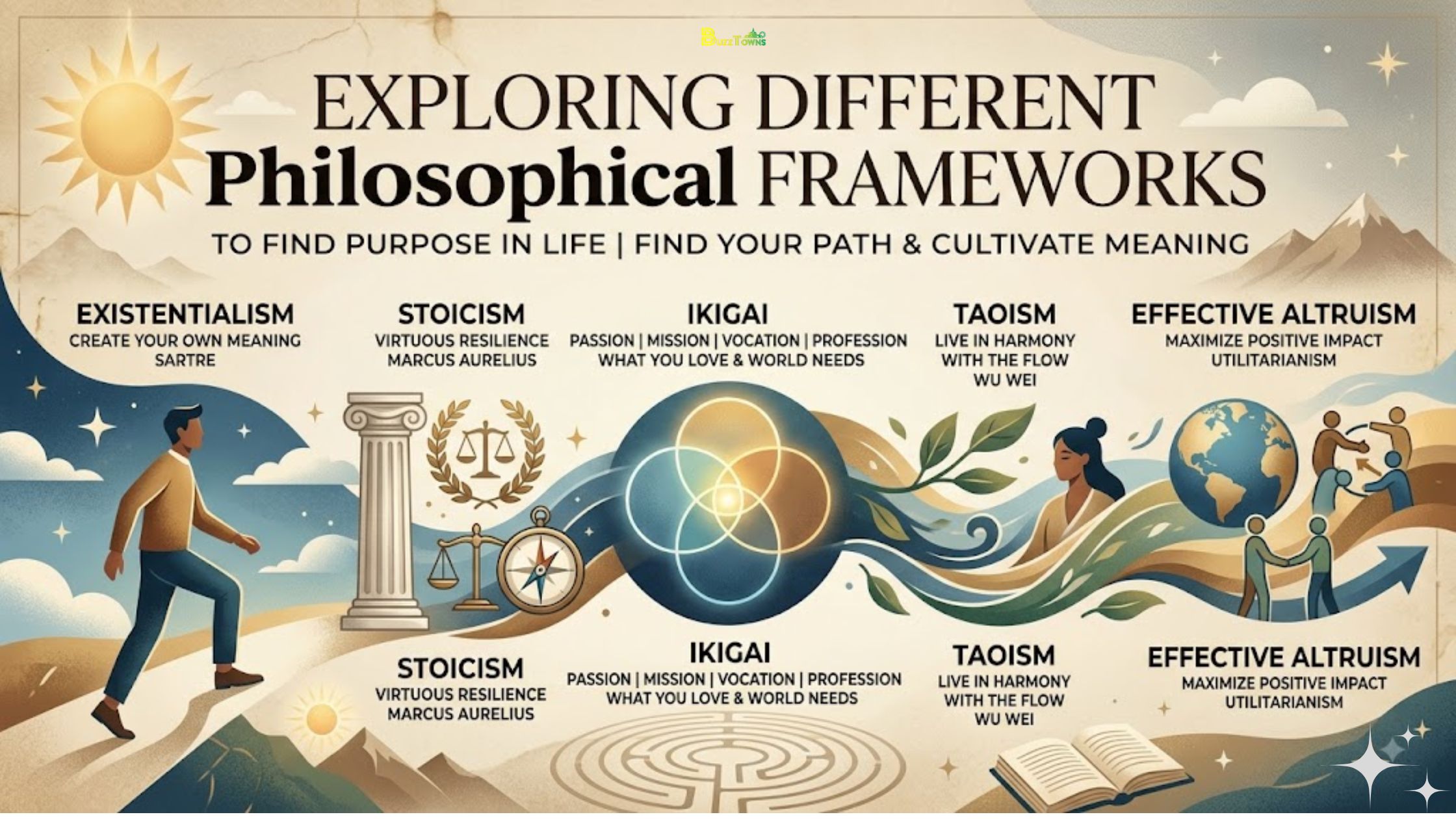
In the mid-20th century, amidst the aftermath of world wars and rapid modernization, existentialism emerged as a powerful response to traditional religious and metaphysical dogmas. Central thinkers like Jean-Paul Sartre, Simone de Beauvoir, and Albert Camus proposed a radical baseline truth: existence precedes essence.
Under traditional pre-modern views, objects (and people) were thought to be designed with a purpose in mind—a paperknife is built specifically to cut paper. Existentialists argued that humans are fundamentally different: we are born first into an indifferent universe without any blueprint, and only then must we define who we are through our choices, actions, and commitments.
Key Insights of Existentialism:
- Radical Freedom and Responsibility: You are the author of your life. While external circumstances are often out of your control, how you react and who you become rests entirely in your hands.
- Overcoming “Bad Faith”: Sartre warned against bad faith (mauvaise foi)—living passively according to social expectations, peer pressure, or institutional rules while claiming you “had no choice.”
- Embracing the Absurd: Camus suggested that life has no inherent, built-in meaning. Instead of despairing, we should accept this “absurdity” and rebel against it by living passionately, authentically, and intentionally.
“Life has no meaning a priori… It is up to you to give it a meaning, and value is nothing but the meaning that you choose.” — Jean-Paul Sartre
2. Stoicism: Aligning with Virtue and Nature
If existentialism feels dauntingly open-ended, Stoicism provides a structured, pragmatic approach grounded in resilience, virtue, and emotional balance. Originating in ancient Greece and popularized in Rome by Epictetus, Seneca, and Emperor Marcus Aurelius, Stoicism views purpose not as an abstract dream, but as a daily practice of moral excellence and emotional mastery.
For the Stoics, the universe is governed by reason (Logos), and living a good life (Eudaimonia) means living in harmony with rational human nature. Among the different philosophical frameworks available, Stoicism stands out for its sharp distinction between what is within our control and what is not.
The Four Cardinal Virtues of Stoicism:
- Wisdom (Phronesis): Navigating complex situations in a logical, informed, and calm manner.
- Courage (Andreia): Facing daily challenges, hardship, and moral dilemmas without fear or cowardice.
- Justice (Dikaiosyne): Treating others fairly, contributing to the common good, and respecting society.
- Temperance (Sophrosyne): Exercising self-restraint, moderation, and self-control in all things.
By focusing solely on our own moral character and actions while accepting external events with equanimity (amor fati, or love of fate), Stoicism transforms everyday difficulties into fuel for personal growth.
3. Eastern Wisdom: Ikigai and Taoism
While Western philosophy often emphasizes individual agency and rational analysis, traditional Eastern paradigms tend to focus on harmony, interconnectedness, and natural flow. Two of the most influential models for finding purpose in Eastern thought are the Japanese concept of Ikigai and the Chinese philosophy of Taoism.
Ikigai: The Intersection of Being and Doing
Translated as “a reason for being,” Ikigai is a practical framework popular in Japanese culture. It suggests that purpose is found at the intersection of four core life domains:
- What you love (your passion)
- What you are good at (your profession/skills)
- What the world needs (your mission)
- What you can get paid for (your vocation)
When these four areas align, you experience a harmonious blend of personal satisfaction and social contribution, generating a sustained, quiet sense of everyday fulfillment.
Taoism: Living in Harmony with the Flow
Founded by Lao Tzu, Taoism teaches that true purpose is found not by striving aggressively against the current of life, but by living in accordance with the Tao (the Way)—the underlying natural order of the universe. Through the practice of Wu Wei (effortless action or natural action), Taoism invites us to release excessive ego control, observe nature, and allow our purpose to unfold organically through calm awareness.
4. Utilitarianism and Effective Altruism: Purpose Through Impact
For those who find personal satisfaction through helping others, moral philosophies like Utilitarianism offer a clear, outward-looking framework for life’s purpose. Championed by Jeremy Bentham and John Stuart Mill, Utilitarianism argues that the moral worth of an action is determined by its utility—specifically, its ability to maximize happiness and reduce suffering for the greatest number of beings.
In modern times, this thought system has evolved into Effective Altruism, a movement advocated by philosophers like Peter Singer. In this modern context, purpose comes from using evidence, critical reasoning, and practical resources to achieve the maximum positive impact possible.
For adherents of this framework, life is not merely about personal self-actualization, but about acting as a force for good in a complex world—whether through strategic charitable giving, ethical career choices, or systemic social improvement.
5. Nihilism and Absurdism: Finding Freedom in Nothingness
At first glance, Nihilism—the belief that life lacks intrinsic meaning, objective value, or ultimate purpose—might sound depressing. Friedrich Nietzsche famously warned of the cultural crisis that would follow the collapse of traditional religious frameworks. However, modern thinkers often distinguish between destructive nihilism and optimistic nihilism.
Optimistic Nihilism posits that if the universe does not provide a pre-packaged purpose, then we are completely liberated from cosmic expectations. There is no predetermined grand masterplan you can fail at. You are free to enjoy the present moment, love others, appreciate art, and explore curiosity simply for the joy of experiencing it.
Absurdism, closely linked to Albert Camus, urges us to accept the tension between our human desire for meaning and the quiet silence of the universe, choosing to live with passion, freedom, and defiance anyway.
Comparative Overview of Frameworks
Comparing these different philosophical frameworks highlights how each offers a distinct perspective on purpose, duty, and human contentment:
| Philosophical Framework | Core Origin of Meaning | Primary Practical Action |
| Existentialism | Self-created through conscious choice | Act authentically; take total personal responsibility |
| Stoicism | Virtue, reason, and natural harmony | Master internal responses; practice the cardinal virtues |
| Ikigai / Taoism | Balance of skills, passion & natural flow | Align daily activities; practice effortless action (Wu Wei) |
| Utilitarianism | Maximizing happiness & reducing pain | Help others systematically and make evidence-based choices |
| Optimistic Nihilism | Freedom from cosmic rules & expectations | Enjoy the present moment; embrace complete creative freedom |
How to Construct Your Personal Life Philosophy
You do not need to adhere strictly to a single school of thought. In fact, many of history’s most thoughtful individuals constructed a personal hybrid philosophy by borrowing the best ideas from different philosophical frameworks.
Here is how you can begin assembling your own meaningful framework today:
- Audit Your Values: Identify what truly matters to you—whether it is personal freedom (Existentialism), quiet resilience (Stoicism), social contribution (Utilitarianism), or creative expression.
- Differentiate Control from Noise: Adopt the Stoic practice of focusing your energy exclusively on your own choices, attitudes, and character, letting go of things you cannot change.
- Seek Alignment (Ikigai): Periodically evaluate your daily routine. Are your skills, passions, income sources, and contributions working together in relative balance?
- Embrace Authentic Responsibility: Remember the existentialist mandate: no one is coming to write your story for you. Take ownership of your destiny and act in alignment with your deepest truths.
Final Thoughts: The Journey is the Destination
Finding purpose is rarely a single “eureka” moment where everything suddenly clicks into place forever. Instead, it is an ongoing, lifelong conversation with yourself and the world around you. By engaging with these different philosophical frameworks, you gain access to thousands of years of human wisdom, equipping you to navigate life’s inevitable storms with clarity, grace, and steady direction.
Ultimately, the meaning of life is not something you discover hidden under a rock—it is something you actively weave into existence through every choice you make, every hardship you endure, and every act of love and curiosity you extend to the world.