
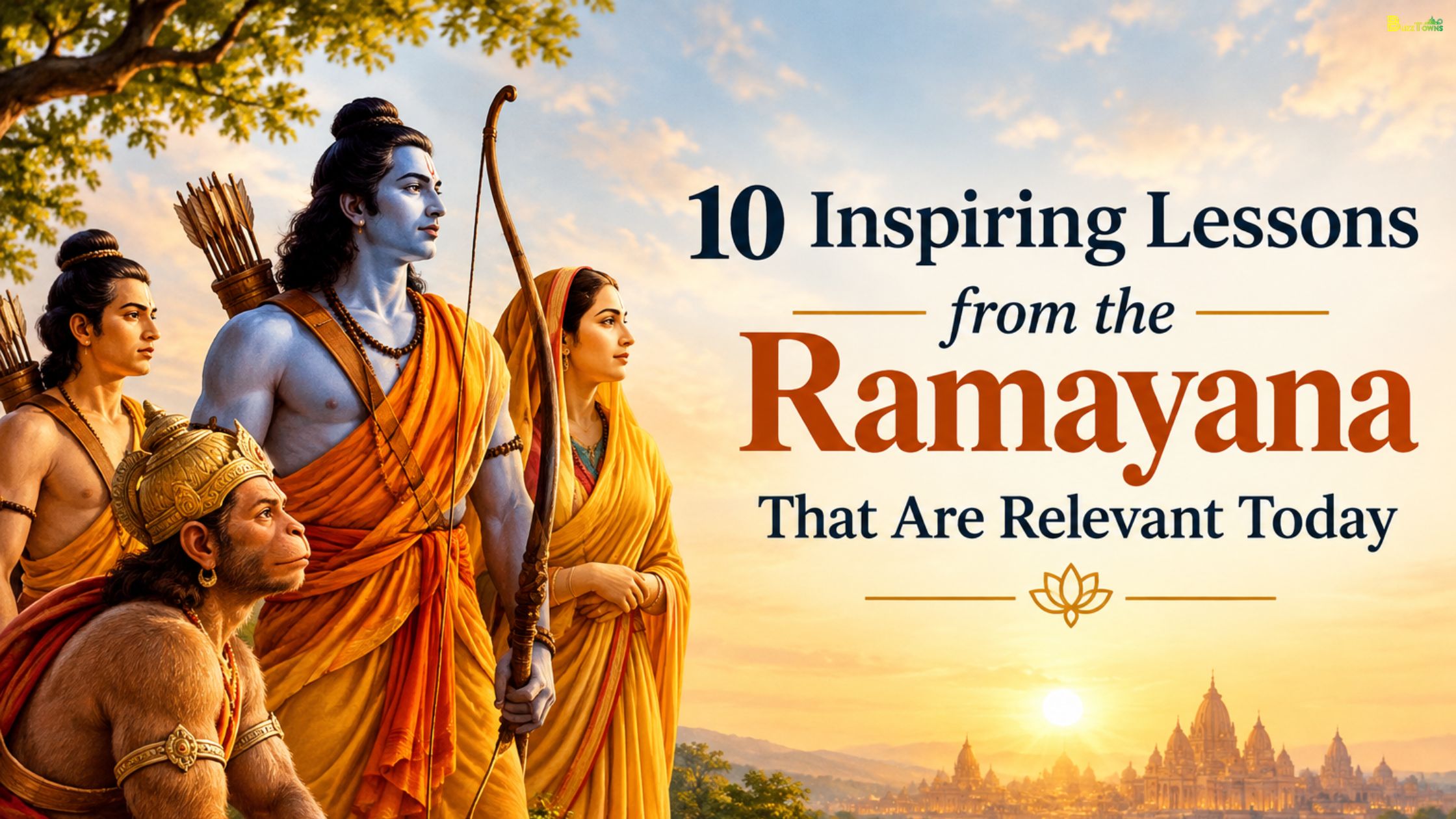
The Ramayana is much more than an ancient Indian epic. It is a timeless story of love, family, courage, sacrifice, loyalty, and the eternal struggle between good and evil. For generations, Indian families have grown up listening to the stories of Lord Rama, Goddess Sita, Lakshmana, Hanuman, and Ravana. These stories have been passed down by grandparents, shared during festivals, and brought to life through Ramlila performances, television shows, and everyday conversations.
But have you ever wondered how the teachings of the Ramayana can help us in our modern lives?
Today, we live in a fast-paced world where people often struggle with stress, family conflicts, career pressure, broken relationships, and the desire for success. In such times, the wisdom of the Ramayana can remind us of the values that truly matter.
Whether you are a student, a working professional, a parent, or someone trying to become a better person, these ten lessons from the Ramayana can offer meaningful guidance.
Let’s explore these timeless teachings and understand how we can apply them in our daily lives.
1. Always Stand by the Truth
One of the most important lessons from the Ramayana is the value of truth and integrity. Lord Rama is widely remembered for his commitment to dharma—the path of righteousness and moral responsibility.
When Kaikeyi asked King Dasharatha to fulfil his promises, Rama accepted his fourteen-year exile rather than allowing his father’s word to be broken. His decision reflected his commitment to duty, even when it came at a personal cost.
How is this relevant today?
In today’s world, it can be tempting to take shortcuts to achieve success. People may exaggerate their achievements, break promises, or compromise their values to get ahead in life.
The Ramayana reminds us that real success is not just about what we achieve but also about how we achieve it.
For example, a student who works hard and earns good marks honestly builds a stronger foundation than someone who cheats. Similarly, an employee who admits a mistake and takes responsibility earns more lasting respect than someone who blames others.
The lesson: Always choose honesty over convenience. Your integrity is one of your most valuable possessions.
2. Respect Your Parents and Family, but Make Thoughtful Choices
Family plays a central role in the Ramayana. Rama’s relationship with his parents, his bond with Lakshmana, and his connection with Bharat highlight the importance of love, respect, and responsibility within a family.
Bharat’s actions are particularly inspiring. Although he had the opportunity to become king, he refused to take advantage of Rama’s absence. Instead, he placed Rama’s sandals on the throne and governed Ayodhya as a caretaker until Rama returned.
His actions showed that family love is not about competition or personal gain. It is about supporting one another and doing what is right.
How is this relevant today?
In many Indian households, family expectations influence important decisions about education, careers, marriage, and lifestyle. While respecting parents and elders is important, healthy family relationships also require understanding, open communication, and mutual respect.
We can learn from the Ramayana by listening to our elders, appreciating their sacrifices, and supporting our family members during difficult times.
At the same time, respect should go hand in hand with thoughtful decision-making. Modern families become stronger when generations can discuss their differences with kindness.
The lesson: Value your family, keep your promises, and build relationships on love, trust, and mutual understanding.
3. True Friendship Is Based on Loyalty and Trust
The friendship between Lord Rama and Sugriva teaches us that genuine relationships are built on trust, support, and shared responsibility.
When Sugriva was facing difficulties and had lost his kingdom, Rama agreed to help him. In return, Sugriva promised to help Rama find Sita. Their alliance became an important part of the journey to Lanka.
Their relationship shows that friendship is not simply about spending happy moments together. It also means standing beside someone when life becomes difficult.
How is this relevant today?
In the age of social media, we may have hundreds of online friends but only a few people we can truly depend on.
A real friend is someone who listens without judging, celebrates your achievements without jealousy, and offers support when you feel lost.
For example, if a friend is going through financial trouble, emotional stress, or a difficult phase in their career, offering practical help or simply being present can make a meaningful difference.
However, true friendship also requires honesty. Supporting a friend does not mean agreeing with every decision they make. Sometimes, a caring friend must gently point out when something is wrong.
The lesson: Be the kind of friend who offers loyalty, honesty, and support—not just words.
4. Humility Is More Powerful Than Pride
Ravana was highly knowledgeable, powerful, and accomplished. He was also a great devotee of Lord Shiva. Yet his pride, arrogance, and refusal to listen to wise counsel contributed to his downfall.
Despite receiving advice from people such as Vibhishana, Ravana refused to change his course. His story reminds us that intelligence and power alone cannot protect a person from the consequences of arrogance.
The Ramayana also presents Hanuman as a remarkable example of strength combined with humility. Despite his extraordinary abilities and heroic deeds, Hanuman remained devoted to Lord Rama and focused on his duty.
How is this relevant today?
We often associate success with wealth, status, qualifications, popularity, or professional achievements. These things can be valuable, but they do not automatically make someone wise or good.
A person who refuses to accept feedback may struggle to grow, while someone who remains humble can learn from almost any experience.
In the workplace, for instance, a successful manager who listens to junior employees may build a stronger team than one who believes they are always right.
Similarly, in family life, admitting a mistake can resolve an argument far more effectively than allowing ego to take control.
The lesson: Be confident in your abilities, but remain humble enough to learn, listen, and improve.
5. Courage Means Doing What Is Right, Even When It Is Difficult
The Ramayana is filled with examples of courage. Rama faces exile, dangerous forests, powerful enemies, and the challenge of rescuing Sita. Lakshmana stands beside his brother through hardship, while Hanuman undertakes the extraordinary journey across the ocean to Lanka.
Hanuman’s journey is especially inspiring. When he learns that Sita is in Lanka, he overcomes enormous obstacles to find her and deliver Rama’s message of hope.
His courage is not simply physical strength. It is the determination to act despite uncertainty and difficulty.
How is this relevant today?
Courage is not limited to fighting battles or performing heroic acts. In everyday life, it can mean speaking up against bullying, reporting corruption, standing up for someone being treated unfairly, or starting again after a setback.
A student may need courage to admit that they are struggling with their studies. An employee may need courage to raise concerns about unethical practices. A young person may need courage to choose a career that genuinely suits their abilities and interests.
Being brave does not mean never feeling afraid. It means refusing to let fear make every decision for you.
The lesson: Do not wait for life to become easy before doing the right thing. Sometimes, courage begins with one small but honest action.
6. Choose Your Company Wisely
The people around us can influence our thoughts, decisions, habits, and ambitions. The Ramayana illustrates this through several characters whose choices are shaped by the advice and influence they receive.
Manthara’s influence on Kaikeyi played a significant role in the events leading to Rama’s exile. Instead of encouraging understanding and harmony, she fuelled suspicion and insecurity.
In contrast, Vibhishana chose to oppose Ravana when he realised that his brother’s actions were wrong. He eventually joined Rama’s side, demonstrating that righteousness can sometimes require difficult choices, even within one’s own family.
How is this relevant today?
Our friends, colleagues, online communities, and social media feeds can all influence the way we think.
If we constantly surround ourselves with negativity, jealousy, gossip, or unhealthy competition, these attitudes can gradually affect our own behaviour.
On the other hand, spending time with people who encourage learning, kindness, discipline, and personal growth can help us become better versions of ourselves.
This does not mean abandoning people whenever they make mistakes. It means recognising harmful influence and maintaining healthy boundaries.
The lesson: Surround yourself with people who encourage your growth, challenge you constructively, and inspire you to do what is right.
7. Never Give Up Hope During Difficult Times
The journey to rescue Sita was filled with uncertainty. Rama did not know exactly where she was or how he would reach her. Yet he continued searching and eventually received crucial help from Hanuman and the Vanara forces.
The Ramayana reminds us that difficult situations do not always have immediate solutions. Progress often comes through patience, determination, teamwork, and the willingness to keep moving forward.
How is this relevant today?
Modern life brings its own challenges. A person may face repeated job rejections, academic pressure, business losses, financial difficulties, or disappointment in personal relationships.
During such moments, it is easy to feel that nothing will improve.
The Ramayana encourages us to approach difficulties with hope and action rather than helplessness. Sometimes, the next step is not to solve the entire problem but to do one useful thing today.
For example, someone looking for a job can improve their skills, ask for feedback, and continue applying instead of giving up after a few rejections.
Hope does not guarantee that everything will happen exactly as we wish. It helps us find the strength to keep trying and recognise new possibilities.
The lesson: Difficulties are part of life, but they do not have to define your future. Stay patient, seek help when needed, and keep moving forward.
8. Teamwork Can Help You Achieve the Impossible
When Rama needed to cross the ocean and reach Lanka, he did not accomplish the task alone. He received support from Sugriva, Hanuman, Jambavan, and the Vanara forces. The construction of the bridge to Lanka is remembered as a powerful example of collective effort.
Each individual contributed according to their abilities. Hanuman’s strength and intelligence, Jambavan’s guidance, and the efforts of the wider group all played a role in the mission.
The story shows that great achievements often depend on cooperation rather than individual strength alone.
How is this relevant today?
Whether you are managing a household, running a business, organising a community event, or completing a project at work, teamwork makes a difference.
In Indian families, for example, preparing for festivals such as Diwali or Ganesh Chaturthi often becomes easier and more enjoyable when everyone contributes. One person decorates the house, another prepares food, and someone else takes care of guests.
The same principle applies in professional life. A successful team values different skills, shares responsibilities, and respects everyone’s contribution.
Teamwork does not require everyone to be equally talented in the same way. It requires people to work towards a common goal.
The lesson: Do not underestimate the power of collective effort. When people support one another and combine their strengths, even difficult goals can become achievable.
9. Actions Have Consequences
The Ramayana repeatedly explores the relationship between our actions and their consequences. Ravana’s decision to abduct Sita and his refusal to correct his wrongdoing ultimately led to devastating consequences for Lanka.
His downfall was not simply a result of lacking strength. It reflected his unwillingness to respect boundaries, listen to advice, and reconsider his choices.
The epic encourages us to think carefully before acting, especially when emotions such as anger, jealousy, greed, or pride influence our judgement.
How is this relevant today?
In everyday life, small decisions can have long-term effects.
Speaking harshly to a family member in anger may damage a relationship. Spreading an unverified rumour can hurt someone’s reputation. Making an impulsive financial decision may create stress for years.
Similarly, positive actions can build lasting benefits. Keeping promises, treating people fairly, and making responsible choices can strengthen relationships and create trust.
This lesson is not about assuming that every hardship is a punishment for someone’s actions. Life is complex, and many difficulties are outside our control. Rather, it reminds us to take responsibility for the choices we can control.
The lesson: Think before you act. Take responsibility for your mistakes, learn from their consequences, and make wiser choices in the future.
10. Goodness Ultimately Matters More Than Power
The central message of the Ramayana is often expressed through the victory of good over evil. Lord Rama’s victory over Ravana is celebrated during Vijayadashami, also known as Dussehra.
Across India, people burn effigies of Ravana to symbolise the destruction of evil and the triumph of righteousness. The celebrations remind us that negative qualities such as arrogance, greed, anger, and dishonesty must be challenged.
However, the deeper meaning of this tradition goes beyond an annual celebration.
It asks us to reflect on our own behaviour. Are we allowing anger to control us? Do we treat others unfairly because we feel powerful? Are we willing to admit when we are wrong?
The real battle between good and evil is not always fought on a battlefield. Often, it takes place within our own minds and hearts.
How is this relevant today?
In a society where success is frequently measured by money, influence, and social status, the Ramayana reminds us that character matters just as much as achievement.
A person who earns an honest living, cares for their family, helps those in need, and treats others with dignity contributes something valuable to society.
You do not need to be famous or powerful to make a positive difference. Everyday acts of kindness, fairness, and responsibility can create meaningful change.
The lesson: Strive to become a better human being, not merely a more successful one. True greatness lies in how you use your abilities and how you treat others.
How Can We Teach the Lessons of the Ramayana to Children?
The Ramayana is a wonderful way to introduce children to Indian culture, values, and storytelling. Instead of simply asking children to memorise names or events, parents can help them understand the values behind the stories.
Here are a few simple ways to do this:
- Tell stories at bedtime: Share age-appropriate stories about Rama, Sita, Hanuman, and Bharat, and discuss what the characters did.
- Ask meaningful questions: Ask children what they would do if they saw someone being treated unfairly or if a friend made a mistake.
- Connect stories to everyday life: Explain how honesty matters when doing homework, how teamwork helps at school, and why apologising is important.
- Celebrate festivals thoughtfully: During Dussehra and Diwali, explain the stories and traditions associated with the celebrations.
- Lead by example: Children learn from what adults do. Practising kindness, keeping promises, and treating others respectfully can make these lessons more meaningful.
It is also helpful to encourage children to ask questions and think critically. The goal is not merely to tell them what to believe but to help them understand values such as compassion, responsibility, courage, and fairness.
Final Thoughts
The Ramayana has remained an important part of Indian culture because its stories continue to inspire people across generations. Although the epic is rooted in an ancient world, many of the challenges it explores—family disagreements, difficult decisions, personal ambition, loyalty, and the struggle to do what is right—remain familiar today.
From Rama’s commitment to dharma and Bharat’s devotion to his brother to Hanuman’s courage and Ravana’s cautionary example, each character offers lessons that we can reflect on in our own lives.
We may not face the same challenges as the characters in the epic, but we all make choices that shape our relationships, our character, and our future.
The next time you celebrate Dussehra or Diwali, take a moment to think beyond the festivities. Consider which qualities you want to strengthen within yourself and which habits you would like to leave behind.
After all, the true value of an ancient story lies not only in remembering it but also in applying its wisdom to the way we live.
The greatest lesson from the Ramayana is simple: choose righteousness over convenience, humility over ego, kindness over cruelty, and courage over fear—one day at a time.