
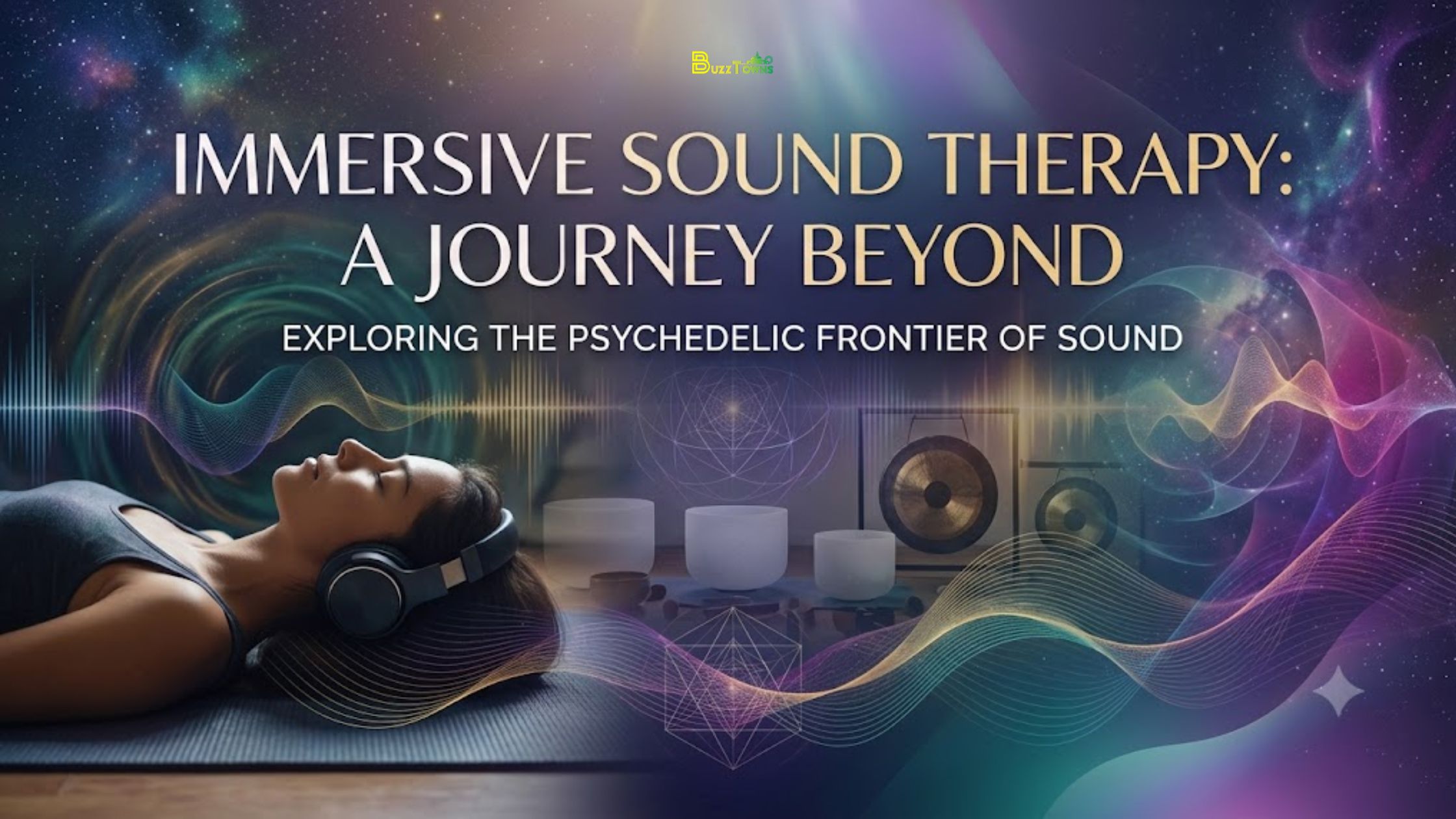
Lie back on a mat in a dimly lit room, close your eyes, and let an ocean of sound envelop you. Within twenty minutes, the boundaries of your physical body soften. Time dilates, thoughts stop marching in linear rows, and vibrant colors or forgotten memories flicker across your mind. It sounds remarkably like an account of a mild psilocybin or ketamine journey, yet no substances were consumed. This is the power of immersive sound therapy mimics—an increasingly popular therapeutic modality that neuroscientists, psychologists, and wellness practitioners are discovering produces neurological and psychological states strikingly similar to classical psychedelics.
What Is Immersive Sound Therapy?
While humans have used drums, chanting, and flutes for healing since antiquity, modern immersive sound therapy combines ancient acoustic traditions with spatial audio engineering and psychoacoustics.
Unlike simply putting on a pair of headphones to stream a lo-fi playlist, immersive sound therapy is designed to envelope the listener completely:
- Multidirectional spatial audio: Multi-speaker arrays or specialized binaural setups deliver frequencies that move through three-dimensional space.
- Harmonic instrumentation: Overtone-rich instruments like Himalayan singing bowls, quartz crystal bowls, massive gongs, and monochords produce layered acoustic vibrations.
- Vibroacoustic transmission: Low-frequency sound waves resonate not just through the ear canal, but physically through bones, tissues, and fluids in the body.
The result is a sensory landscape so rich that the conscious mind relinquishes its habitual vigilance, clearing the way for an altered state of consciousness (ASC).
The Neurological Overlap: Sound Waves vs. Psychedelic Molecules
How can pure sound produce shifts that rival psychoactive plant medicine? The answer lies in how both modalities interact with the central nervous system.
1. Quieting the Default Mode Network (DMN)
The Default Mode Network is a collection of interconnected brain regions responsible for mind-wandering, self-reflection, past-and-future thinking, and our ongoing internal monologue—what many call the “ego.”
- Under psychedelics: Brain imaging studies from Imperial College London and Johns Hopkins show that compounds like psilocybin and LSD drastically suppress DMN activity. When the ego steps aside, rigid thinking dissolves, leading to feelings of oneness and ego dissolution.
- Under immersive sound therapy: Overwhelming the auditory cortex with rich, drone-based overtones starves the DMN of the cognitive resources it requires to sustain everyday rumination. As the analytical mind gives up trying to categorize the complex acoustic input, the DMN downregulates, producing that same sensation of expansive, ego-free presence.
2. Brainwave Entrainment and the Hypnagogic Threshold
Your waking brain typically operates in Beta frequencies (13–30 Hz), characterized by active problem-solving, alertness, and occasional anxiety.
Through a phenomenon known as the frequency following response, your brain synchronizes its electrical oscillations to sustained external rhythmic or harmonic stimuli. Immersive sound therapy reliably shifts brainwaves down into:
- Alpha waves (8–12 Hz): Calm alertness, flow states, and relaxed receptivity.
- Theta waves (4–8 Hz): The hypnagogic realm between waking and sleeping—the exact territory where lucid dreaming, deep meditation, psychedelic imagery, and trauma processing occur.
In prolonged Theta states, the barrier between conscious intent and subconscious material drops, unlocking dreamlike visions, sudden insights, and emotional releases without pharmaceutical intervention.
3. Cross-Sensory Processing: The Rise of Synesthesia
A hallmark of high-dose psychedelic experiences is synesthesia—hearing colors, tasting shapes, or feeling tones as physical textures.
In a session of immersive sound therapy, as your brainwaves dip and spatial sound moves around the room, sensory gating mechanisms loosen. It is common for participants to report vivid geometric visuals, bursts of color corresponding to specific chord structures, or physical sensations of floating. The brain begins cross-wiring sensory inputs precisely as it does under the influence of 5-HT2A receptor agonists.
Comparing the Experiences
While chemically distinct, the subjective landscape between an immersive sound journey and an intentional psychedelic session shares profound territory:
| Dimension | Psychedelic Therapy | Immersive Sound Therapy |
| Primary Mechanism | Chemical (Serotonin 5-HT2A receptor agonism) | Physical / Acoustic (Neural entrainment and sensory overload) |
| Default Mode Network | Markedly suppressed | Significantly downregulated |
| Perception of Time | Nonlinear, dilated, or absent | Distorted, stretches, or passes unnoticed |
| Somatic Processing | Tremors, emotional release, temperature shifts | Vibrational resonance, somatic releases, heavy limbs |
| Agency and Control | Harder to interrupt once metabolized | Immediate return to baseline upon opening eyes |
| Accessibility & Legality | Often restricted, costly, requires medical screening | Widely legal, safe, and easily accessible |
Emotional Catharsis and Somatosensory Release
Psychedelic-assisted psychotherapy is celebrated largely for its capacity to unblock repressed emotions and allow patients to view unresolved trauma without defensive reactivity.
Immersive sound therapy triggers a parallel healing cascade through somatic avenues. High-frequency acoustic overtones combined with heavy sub-bass vibrations bypass intellectual defenses. Many attendees experience sudden weeping, deep sighs, spontaneous shaking, or intense surges of gratitude.
Because the sound vibrates the vagus nerve—the primary highway of the parasympathetic nervous system—it signals to the heart and gut that the body is safe. When the autonomic nervous system enters complete rest-and-digest safety, emotional knots held deep in muscle fascia can finally untangle.
Integrating Sound into Modern Mental Wellness
For individuals curious about the transformative, perspective-shifting benefits of psychedelic experiences—but who may be hesitant due to legal barriers, medication contraindications (such as SSRIs), or anxiety around loss of control—immersive sound therapy provides an accessible, non-pharmacological bridge. Whether through a live acoustic sound bath, a specialized vibroacoustic sound bed, or multi-channel spatial audio studios, sound gives the brain permission to step off the treadmill of hyper-vigilance. By mastering the rhythm and vibration of sound, we unlock ancient, chemical-free pathways back to ourselves.