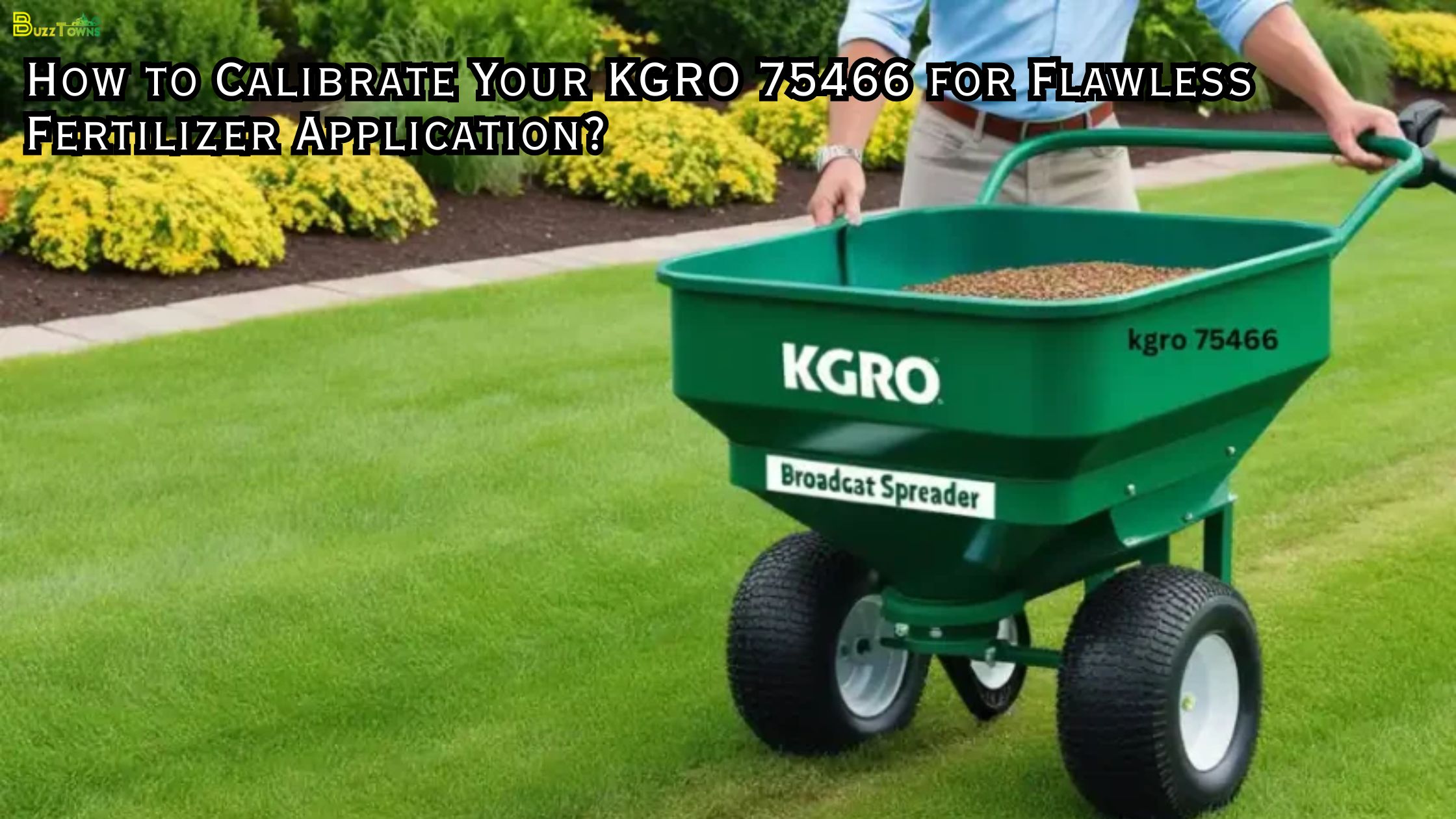
Lawn care enthusiasts and professionals alike know that a beautifully maintained lawn is the result of precision and attention to detail. One of the most important steps to achieving flawless, evenly green turf is the precise application of granular products such as fertilizers, seeds, and weed control. This is where the importance of calibrating your spreader comes in, especially for a classic and reliable model like the KGRO 75466 Broadcast Spreader.
The KGRO 75466 is a broadcast (or rotary) spreader, meaning it distributes material over a wide arc as you press it. While a spreader may have recommended settings printed on the fertilizer bag or in its manual, these are often the starting point. Factors such as the size, shape, and density of the material, age and wear and tear of the spreader, and your running speed can drastically alter the actual spread rate. Without proper calibration, you risk costly misapplication – either over-fertilizing, which can burn your lawn and harm the environment, or under-fertilizing, which leads to weak, irregular growth.
Since the KGRO 75466 is an older or vintage model, it may be difficult to find the original, product-specific calibration chart. Therefore, the most reliable method is to perform a manual calibration test tailored to your specific product, running speed, and machine condition. This detailed, informative guide will walk you through a comprehensive calibration process to ensure that your KGRO 75466 is delivering accurate rates for an ideal lawn.
The Essential Manual Calibration Test for Your KGRO 75466
The goal of this calibration test is to determine how much material (in pounds or kilograms) your KGRO 75466 applies to a known area (usually 1,000 square feet) for a specific flow setting.
Part 1: Preparation and Calculation
Before you begin, gather all the necessary materials and calculate your target application rate.
Materials You Will Need:
- Your KGRO 75466 Broadcast Spreader (clean and dry)
- The granular product you intend to use (fertilizer, seed, etc.)
- A reliable scale (kitchen or postal scale for smaller amounts, or a floor scale for the entire spreader)
- A calculator
- Measuring tape (at least 50-100 feet)
- Four marker flags or cones
- A pen and paper to record your results
Step 1: Determine Your Target Application Rate
The target rate is the specific amount of product you need to apply per unit area, usually provided on the product packaging. It is often expressed in pounds per 1,000 square feet (lb/1,000ft2)
- Example: A bag of fertilizer recommends applying 1 lb of nitrogen per 1,000 square feet. If the guaranteed analysis of the fertilizer is 20−0−0 (meaning 20% of the product is nitrogen by weight), the amount of total product required is:

Record your target rate: Let’s say your target is for testing.
Step 2: Establish the Spreader’s Effective Throw Width
KGRO 75466, as a broadcaster, would throw the content into a pattern. You need to know the effective throw width to determine the width of your test strip and how much to overlap during actual application.
- Place a small amount of product in the spreader hopper.
- Set the control lever to a low-to-medium setting (for example, setting 5).
- Walk a short distance at your normal speed on a hard surface (such as a road or patio), open the controls for a few seconds. Importantly, clear all contents immediately after testing!
- Effectively measure the distance from the center line of the path to the farthest point of the product. This is your half-throw width.
- Multiply the half-throw width by. This is the total throw width.
- Rule of thumb: For rotary spreaders, you generally overlap your passes so that the wheel of the next pass runs just inside the edge of the throw of the previous pass. This means that your next path should start at a distance of one inch from the center of the previous path. For testing purposes, let’s assume your effective application width (the distance you’ll space your passes apart in the field) is.
Step 3: Define Your Test Area
To calculate the amount of fertilizer needed for the test, you will use a manageable, known area. One test is ideal, but for efficiency, one test is often preferred.
- Test Area Calculation:
- Using your effective application width of.

- Mark out a long and wide straight path using your marker flags.
- Calculate the product required for the test area:
- Using the target rate from step 1(5 lb/1,000 sq. ft).

- Record your required test amount:
Part 2: Running the Test
Now you’re ready to test your KGRO 75466 and find the correct setting.
Step 4: Prepare the Spreader and Product
- Initial Weight: Measure an initial amount of product that is significantly larger than your required test amount. For any goal, start with the product. Record this starting weight.
- Choose a starting setting: Choose a setting on your KGRO 75466 that is a reasonable starting point (for example, like a mid-range setting). Record this initial setting.
- Load Spreader: Place measured material into the hopper. Make sure the flow gate is closed.
Step 5: Spread the Material Over the Test Area
- Establish speed: Start walking a few feet past your start marker, pushing the spreader at your normal, comfortable speed. It is important to maintain a consistent walking pace.
- Start dispensing: As soon as the agitator wheel passes the starting marker, quickly pull the lever to open the flow gate to your chosen setting.
- Stop spreading: As soon as the agitator wheel passes the last marker, quickly pull the lever to close the flow gate.
- Cover the area: Turn the spreader around and do your second pass in the opposite direction, keeping the second pass at your predetermined effective application width (in our example) from the first pass. This ensures that your 20 ft x 10 ft test area is completely covered. Remember to open the gate only when moving beyond the measured distance.
Step 6: Measure and Calculate Actual Rate
- Final Weigh: Carefully pour the remaining product from the hopper into your bucket and weigh it on your scale. Record this remaining weight.
- Calculate actual product used: Subtract the remaining weight from your starting weight to find the actual weight used in a 200 square foot test area.

- Determine the actual application rate: Use the following formula to find the actual rate per 1,000 square feet at the setting you used:
- Continuing the example: If you used 1.3 pounds of product, your actual rate is:

Part 3: Adjustment and Final Calibration
Step 7: Adjust the Spreader Setting
Compare your actual application rate to your target application rate (in the example).
If the actual rate is too high (6.5lb in the example), it means your setting was too wide. You will need to DECREASE the setting number (close the gate) and repeat the test.
If the actual rate is too low (e.g., 0.8 lb Used, or 4 lb/1,000 sq. ft), it means your setting was too narrow. You must INCREASE the setting number (open the gate) and repeat the test.
If the actual rate is PERFECT, congratulations! The setting you use is the correct calibration for that specific product and your running speed.
Step 8: Repeat and Record
Repeat the entire test procedure (Part 2) with a new, adjusted setting. It may take two or three tries to find the perfect match.
Once you have achieved the application rate within your target, you have successfully calibrated your KGRO 75466.
- Final Calibration Record Example:
- Product: Lawn Fertilizer
- Target Rate:
- Walk Speed: (Normal pace)
- KGRO 75466 Setting: 9
Best Practices for Flawless Application with Your KGRO 75466
A perfectly calibrated spreader is only part of the equation. To ensure that your application runs flawlessly, follow these best practices:
Consistency is Key
- Maintain running speed: The speed you use during calibration should be the speed you use for the entire application. Slower speed applies more product; Fast walking is less applicable.
- Keep the agitator running: Never stop the agitator running with the flow gate open, as this will cause a large pile of product to build up and seriously burn your turf. Always start walking before opening the gate and close the gate before stopping or turning.
The Half-Rate, Perpendicular Method
Broadcast spreaders apply the product in a “bell curve” pattern – most in the middle and less on the edges. To achieve completely uniform dispersion and eliminate streaks (a common problem with rotary spreaders), use the Half-Rate, Perpendicular Method.
- Halve the calibration rate: Once you have your calibrated setting (for example, setting 9), you will use this setting to apply the full amount of fertilizer to the lawn, but in two perpendicular passes.
- First Pass: Apply half of your total product to the entire lawn in one direction (for example, north to south), making sure you have your predetermined Effective Application Width (10 feet).
- Second pass: Apply the remaining half of your total product over the entire lawn in a direction perpendicular to the first (for example, East-to-West), again keeping your passes at their effective width.
Using this cross-hatch method, the thin edges of the first pass are overlapped by the thin edges of the second pass, resulting in a consistent, lossless application over the entire area.
Maintenance
- Hygiene: Always clean the KGRO 75466 hopper and all working parts immediately after each use. Fertilizer is corrosive and can quickly seize the flow gate or impeller, disrupting your calibration for the next job.
- Recalibrate annually: The internal parts of the KGRO 75466 will wear over time. Recalibrate your spreader at least once a year, and always when you’re switching to a product with a significantly different particle size (for example, from granular fertilizer to fine grass seed).
By following this detailed calibration process and adhering to best application practices, your KGRO 75466 will become a precision tool that will guarantee that your lawn will receive the precise nutrition it needs for a truly flawless, professional-grade finish.