
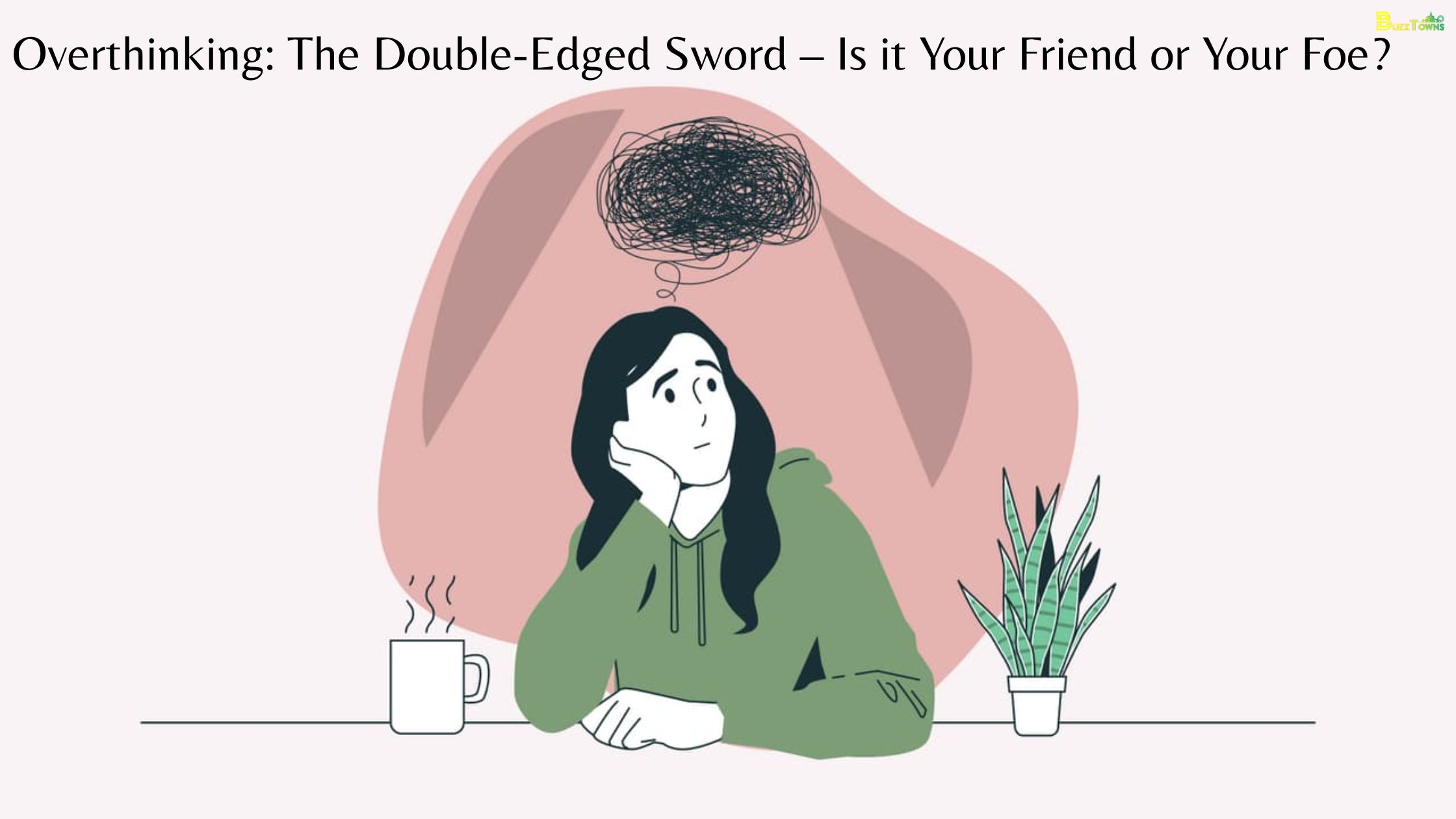
We’ve all been there: waking up at 3 a.m., replaying conversations from three years ago, analyzing every word, intonation, and pause. Or maybe you spent the entire weekend stumped by a decision, assessing every possible positive and negative outcome in detail until the window of opportunity closed.
This is overthinking – a common human experience defined as the tendency to dwell excessively on thoughts, decisions, and situations, past or future. It is this mental process that takes us beyond creative analysis and causes us to fall into a cycle of worry and rumination.
But what if this constant mental engine isn’t just a flaw? What if, in its raw, unfiltered form, it held the key to unique powers? The answer lies in recognizing that overthinking is not an entity, but a double-edged sword – a potential ally to innovation and analysis, or a debilitating enemy of anxiety and paralysis.
⚔️ The Foe: When Overthinking Becomes Toxic
When overthinking crosses the line from deep thought to destructive obsession, it manifests in two primary ways, which destroy both mental and physical well-being: rumination and worry.
1. Rumination: The Past’s Prison
Rumination is the act of endlessly replaying past events, often focusing exclusively on mistakes, perceived failures, or “what could have been done differently.” This is backwards and is heavily linked to depression.
- Problem: By trapping you in the past, rumination leads to self-recrimination, regrets, and guilt. This is a non-productive loop that drains energy without offering solutions, making it difficult to feel emotionally optimistic about the present or the future.
2. Worry: The Future’s Fear
Anxiety is the future-oriented cousin of contemplation. It involves obsessively imagining possible negative outcomes, often jumping to the worst-case scenario, failure, or rejection. It is closely linked to generalized anxiety.
- Problem: Analysis paralysis. Excessive worrying can lead to a condition often referred to as “analysis paralysis.” Considering the sheer volume of possibilities and potential risks can make even simple decisions seem overwhelming. The thinker becomes stuck, unable to follow any path for fear that it won’t be “perfect”, leading to procrastination and missed opportunities.
The Detrimental Toll
Chronic overthinking is not just frustrating; it has measurable negative impacts on health and life:
| Area | Impact of Excessive Overthinking |
| Mental Health | Strong correlation with anxiety disorders, chronic stress, and depression. |
| Decision-Making | Leads to indecision (paralysis) and self-doubt, even after a choice is made. |
| Relationships | Can cause misinterpretations, unnecessary conflict, and emotional exhaustion due to constantly seeking reassurance or assuming negative intent. |
| Physical Health | The continuous state of mental stress elevates cortisol levels, contributing to insomnia, headaches, fatigue, and digestive issues. |
🛡️ The Friend: The Secret Strengths of the Deep Thinker
To label all deep, profound thoughts as “bad overthinking” is to miss the important forces hidden beneath the surface. Many highly effective people—innovators, researchers, engineers—are, in fact, “overthinkers” who have learned to channel their cognitive intensity.
When channeled constructively, an over-thinker’s mental wiring translates into powerful cognitive benefits:
1. Superior Problem-Solving and Preparedness
The brain of an overthinker naturally runs simulations. Although it may feel like anxiety, it is also a powerful evolutionary tool for survival and success.
- Creative Application: A channeled overthinker analyzes an issue from multiple angles, considering contingencies and potential obstacles that others overlook. This systematic approach leads to well-thought-out solutions, increases preparedness for different scenarios, and reduces the likelihood of serious mistakes. They are planners who already have a “Plan B” and “Plan C” ready.
2. Enhanced Attention to Detail (The Precision Advantage)
The tendency to examine every aspect of a situation or interaction means that the overthinker is often the master of details.
- Creative Applications: This feature is invaluable in fields requiring high precision such as engineering, medicine, data analysis, or finance. They pick up on subtle non-verbal cues, notice logical inconsistencies, and do the careful work that sets them apart.
3. Creativity and Innovation
Many successes in history have come from individuals who could not stop struggling with an idea. The continued exploration of possibilities and the refusal to rush toward “cognitive closure” are hallmarks of both thinking and innovation.
- Creative Application: When focused on challenge rather than fear, the overthinker’s brain is highly creative, giving rise to new concepts and connections. They willingly revisit topics repeatedly, allowing ideas to flourish and evolve – which is key to innovation and the complex learning process.
4. High Self-Awareness and Empathy
A person who constantly analyzes his or her actions and words – often critically – naturally has a high level of self-awareness.
- Constructive Application: This awareness, when fueled by self-compassion, allows them to understand their personal triggers, emotional reactions, and values better than other people. Furthermore, their keen observation of others’ tone and body language often makes them incredibly empathetic. They are friends who genuinely care about whether they have committed a crime and try to understand others’ perspectives.
🎯 Transforming the Foe into a Friend: Actionable Strategies
The goal is not to “stop thinking” (an impossible task), but to shift cognitive effort from unproductive contemplation to productive analysis. The main thing is to manage the duration and direction of the thought process.
1. Mindfulness: Noticing vs. Engaging
The most powerful tool to break the cycle of overthinking is mindfulness.
- Technique: Instead of getting caught up in the thought (believing the disaster is real), step back and view the thought as a mental event. Label the thought: “I’m having an anxious thought about tomorrow’s presentation.” This creates distance between you (the observer) and the thought (the event). An opinion is not a fact.
2. The Thought Scheduling Tool
Establish a limit for when overthinking is allowed.
- Technique: Designate a specific “worry time” (for example, 15 minutes at 6:00 p.m.). If a worrying thought or rumination comes up outside this window, immediately acknowledge it, and consciously postpone it: “I’ll think about this text message analysis during my worry time at six o’clock.” It acknowledges the brain’s need to process the present moment without taking it away.
3. Challenge Cognitive Distortions
Overthinking often relies on flawed reasoning, or cognitive distortions, such as:
- Catastrophizing: Considering the worst-case scenario as the most likely.
- All-or-nothing thinking: Seeing things only in terms of success or complete failure.
- Overgeneralization: Applying a negative event to every future situation.
- Challenge: When a worrying thought comes up, ask yourself: “Is it based on fact or assumption?” and “What is the most likely (not worst) outcome?” This forces the rational mind to take over the wheel.
4. Embrace the “Good Enough” Decision (The 80/20 Rule)
For most decisions (such as choosing a restaurant or a new pair of shoes), getting the “right” outcome is statistically impossible and a waste of energy.
- Technique: Set a time frame for analysis. If the decision meets 80% of your criteria within that range, commit to it. By acknowledging that action is better than perfection, you fight analysis paralysis and create momentum.
The Verdict
Overthinking is neither completely friend nor an enemy; This is raw cognitive power. When left directionless, it harms our peace and performance. But when recognized, managed, and intentionally focused—when that same intense mental energy is channeled into preparation, problem-solving, and empathy—it becomes a source of profound powers and deep insight. The fight against overthinking is not about quieting the mind, but about changing its owner. By learning to label thoughts, set boundaries, and prioritize action over endless analysis, deep thinkers can turn their biggest weakness into their defining competitive edge.