
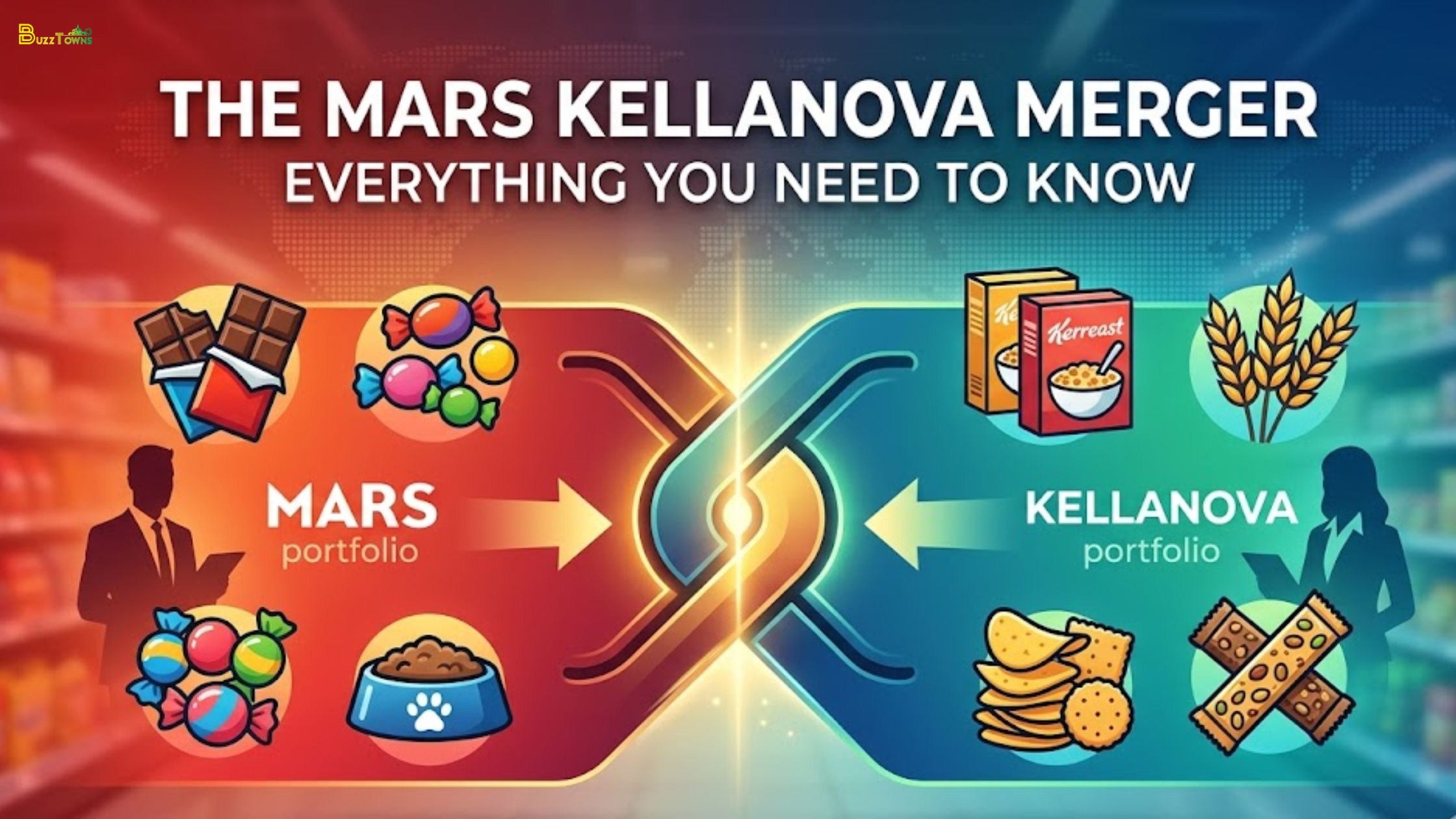
Think about the last time you walked down the snack aisle. On one side, you have the sweet, chocolatey staples like M&M’s and Snickers. On the other, the salty, savory crowd-pleasers like Pringles and Cheez-Its. For decades, these brands belonged to entirely separate corporate universes. Today, they are teammates.
The Mars Kellanova mega-merger stands as one of the largest and most consequential acquisitions in the history of the packaged food industry. By bringing Kellanova into the fold, Mars has fundamentally rewritten the rules of the global food market.
Whether you are an industry analyst tracking the retail market, an investor looking at consumer goods, or simply someone who loves a good mid-afternoon snack, here is a complete breakdown of everything you need to know about this massive corporate union.
📊 The Deal by the Numbers
To truly grasp the scale of the Mars Kellanova integration, you have to look at the sheer financial weight of the transaction. This wasn’t just a standard corporate buyout; it was a definitive power move.
- The Price Tag: Mars acquired Kellanova for $83.50 per share in cash, culminating in a total enterprise value of roughly $36 billion (including debt).
- The Timeline: The definitive agreement was first announced on August 14, 2024. After navigating rigorous shareholder votes and regulatory reviews, the acquisition officially closed on December 11, 2025.
- The Revenue Surge: The newly expanded Mars Snacking business alone is projected to pull in roughly $36 billion in annual revenues.
- The Footprint: The combined enterprise now boasts a powerhouse roster that includes 9 billion-dollar brands, operates 80 global production facilities, and utilizes a massive workforce of over 50,000 snacking associates globally.
🍿 The Strategic Pivot: Why Mars Bought Kellanova
For decades, Mars has been synonymous with world-class confectionery. Brands like Snickers, Twix, and Skittles dominate checkout counters globally. However, relying purely on chocolate and candy carries inherent risks. Sugar trends are shifting, cocoa supply chains have faced extreme climate-driven volatility, and consumer preferences are tilting toward all-day, “better-for-you” snacking.
By acquiring Kellanova, Mars executed a brilliant diversification strategy:
1. Conquering the Savory Snack Aisle
Before the merger, Mars lacked a major footprint in salty snacks. Kellanova handed them the keys to absolute giants in this space—most notably Pringles and Cheez-It. Savory snacks tend to have higher everyday consumption frequencies than sweet candy bars, providing a steady, reliable revenue stream that balances out seasonal candy drops (like Halloween or Easter).
2. International Scaling Opportunities
Kellanova was already a global force, but Mars possesses an unparalleled international distribution network spanning over 145 markets. By routing Kellanova’s flagship brands through Mars’ existing global supply chain pipelines, they can rapidly scale products like Pop-Tarts and Rice Krispies Treats into new geographic regions where they haven’t yet reached peak penetration.
3. Strengthening the “Accelerator” Portfolio
Beyond the heavy hitters, Kellanova brought a highly strategic wellness and bar division. Brands like RXBAR, Nutri-Grain, and Special K bars have seamlessly joined Mars’ Accelerator division (which already managed brands like KIND and Nature’s Bakery). This instantly positions the combined company as a top-tier player in healthy, functional, on-the-go nutrition.
🍪 The Combined Brand Empire
To visual just how much market share the Mars Kellanova entity holds, look at how the master pantry is organized under the Mars Snacking umbrella:
| Product Category | Legacy Mars Brands | Newly Added Kellanova Brands |
| Chocolate & Candy | M&M’S, Snickers, Twix, Dove, Skittles, Milky Way | N/A |
| Salty & Savory Snacks | Combos | Pringles, Cheez-It |
| Toaster Pastries & Treats | N/A | Pop-Tarts, Rice Krispies Treats |
| Bars & Wholesome Snacking | KIND, Nature’s Bakery | RXBAR, Nutri-Grain, Special K Bars |
| Gum & Mints | Extra, Orbit, Juicy Fruit | N/A |
⚖️ Overcoming the Regulatory Gauntlet
When a deal of this magnitude drops, antitrust watchdogs naturally perk up. Regulators in both the United States and Europe subjected the Mars Kellanova merger to intense, fine-toothed scrutiny.
The primary concern among regulators wasn’t necessarily direct product overlap. After all, Mars didn’t make a potato chip to compete with Pringles, and Kellanova didn’t make a chocolate bar to compete with Snickers. Instead, regulatory bodies like the European Commission investigated a “bargaining theory of harm”.
What is the Bargaining Theory of Harm?
Regulators worried that by stacking its portfolio with so many iconic, must-have grocery items, the combined Mars-Kellanova entity would hold immense leverage over supermarkets. In theory, they could dictate shelf space or pressure retailers into accepting higher prices across the board, potentially driving up costs for everyday shoppers.
Ultimately, both the U.S. Federal Trade Commission (FTC) and the European Commission cleared the deal unconditionally. Extensive market research proved that the rise of private-label grocery brands, combined with a highly fragmented snack market, would preserve healthy competition and protect consumer pricing.
🛒 What This Means for Consumers and Retailers
Now that the ink is dry and the corporate integration is fully underway, what changes will we actually see in the real world?
For the Everyday Shopper
In the immediate term, your grocery store routine won’t look entirely different. Your favorite snacks aren’t disappearing, and the recipes aren’t changing. However, behind the scenes, expect to see cross-brand promotions and creative marketing campaigns.
While it’s unlikely we will see a “Snickers-flavored Pringle” anytime soon, you can expect to see coordinated seasonal displays, bundle discounts (like buying game-day soda, Cheez-Its, and M&M’s all in one package), and co-branded retail experiences.
For the Retail Industry
Supermarkets, convenience stores, and big-box retailers are adjusting to a new dynamic. Dealing with a unified Mars Kellanova account team simplifies the supply chain logistics for buying departments. Instead of managing separate orders, shipments, and invoices for multiple distinct snacks, corporate buyers can coordinate massive distribution orders under a singular corporate umbrella.
🌿 The Focus on Sustainability
Mars has long emphasized its corporate commitment to sustainability, operating under a framework it calls the “Five Principles” (Quality, Responsibility, Mutuality, Efficiency, and Freedom). A major narrative pushed by leadership during the integration involves bringing these strict environmental goals to Kellanova’s massive production network.
Mars plans to heavily invest in sustainable agricultural sourcing for palm oil, wheat, and corn—the core raw inputs for Kellanova’s snack lineup. Furthermore, the company is actively pushing to optimize packaging across both product lines, aiming to reduce virgin plastic usage and implement fully recyclable or compostable wrapping materials for single-serve snack packs over the coming years.
🔮 The Bottom Line
The completion of the Mars Kellanova merger marks the dawn of a true modern snacking empire. By successfully blending Mars’ century-long expertise in confectionery with Kellanova’s dominance in savory staples and breakfast snacks, the combined company is perfectly positioned to capture a larger share of consumers’ daily habits. It is a masterclass in strategic corporate growth: evolving beyond traditional candy lanes to build a resilient, multi-category food giant that is ready for the future.