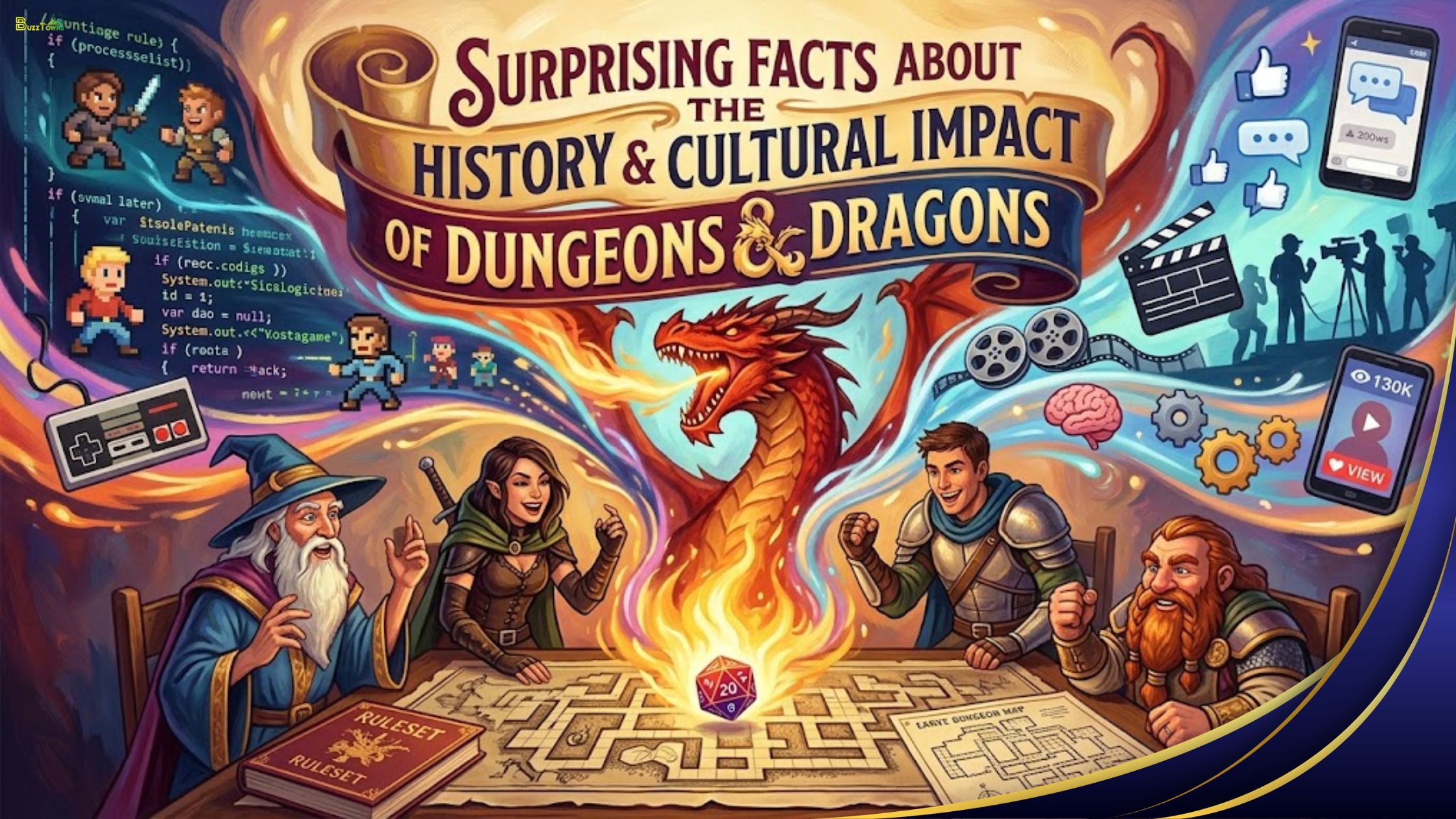
In 1974, two wargaming hobbyists in Lake Geneva, Wisconsin, assembled a small, woodgrain-boxed set containing three staple-bound booklets and reference sheets. Hand-assembled in a basement, the game carried an unconventional premise: instead of moving armies across a map to annihilate an opponent, players each inhabited a single persona, rolling twenty-sided dice to navigate verbal puzzles and perilous subterranean labyrinths. That obscure tabletop experiment was Dungeons & Dragons (D&D). Co-created by Gary Gygax and Dave Arneson, it did not merely spawn an eccentric subculture; it authored the grammar of modern narrative media. From prestige streaming television and contemporary screenwriting rooms to the architecture of multi-billion-dollar video game engines, the cultural impact of Dungeons & Dragons stretches far beyond grease-pencil character sheets and plastic polyhedral dice.
1. It Sparked Modern Video Games and the Digital RPG
Every time you gain an experience point (XP), unlock a skill tree, balance armor statistics, or embark on an open-world quest in games like Baldur’s Gate 3, The Witcher, Elden Ring, or World of Warcraft, you are walking directly through Gary Gygax’s rulebook.
In the late 1970s and early 1980s, mainframe programmers at universities were avid tabletop fans. Wanting to recreate the thrill of tactical role-playing on university networks like PLATO, engineers coded early dungeon crawlers such as pedit5, dnd, and Rogue. These digital experiments crystallized core tabletop conventions into software:
- Quantified Character Growth: The translation of physical and mental capabilities into tangible numerical stats (Strength, Dexterity, Constitution, Intelligence, Wisdom, Charisma).
- Hit Points and Resource Pools: Adapting naval wargame damage rules to individual hero vitality, now standard across nearly all gaming genres.
- Procedural Narrative: Allowing player choice, rather than hardcoded linear cutscenes, to dictate the trajectory of a story.
Without the mechanical foundation laid by tabletop role-playing, our modern digital entertainment landscape would look fundamentally unrecognizable.
2. The 1980s “Satanic Panic” Inadvertently Created an Empire
During the early 1980s, D&D found itself square in the crosshairs of moral outrage. Driven by sensationalized tabloid journalism, daytime talk shows, and religious advocacy groups like B.A.D.D. (Bothered About Dungeons and Dragons), critics alleged the game promoted demon worship, witchcraft, and psychological instability among youth.
This moral crusade culminated in sensationalist media, including the famous anti-D&D television movie Mazes and Monsters (1982), starring a young Tom Hanks, and widely circulated fundamentalist comic tracts.
Yet, this moral panic delivered an unexpected biological counter-reaction: free, relentless publicity. For millions of curious teenagers across suburban North America and Europe, the sheer horror of their parents made D&D the ultimate countercultural talisman. Sales skyrocketed through the roof. The controversy transformed an insular wargaming hobby into a mainstream youth phenomenon, cementing its rebellious cachet in the cultural zeitgeist.
3. The Unsung Forge of Modern Screenwriting and Pop Culture
Look closely at the creators behind contemporary popular culture, and you will routinely find a former Dungeon Master holding the pen.
Writing episodic television or directing dynamic cinema shares structural DNA with running a tabletop campaign: both require ensemble pacing, character agency, high-stakes moral dilemmas, and collaborative improvisation.
A remarkable roster of influential creatives cut their storytelling teeth behind DM screens:
- The Duffer Brothers: Directly infused the show Stranger Things with D&D lore, using the Demogorgon, Mind Flayer, and Vecna as central antagonists.
- George R.R. Martin: Long an avid tabletop player and gamer, Martin’s morally complex, consequence-heavy narrative style in A Song of Ice and Fire / Game of Thrones reflects the brutal unpredictability of high-level tabletop encounters.
- Community & Rick and Morty: Dan Harmon famously utilized D&D episodes to unpack intricate interpersonal group dynamics, openly acknowledging how collaborative roleplay influences his narrative circles.
Hollywood heavyweights from Vin Diesel and Robin Williams to Joe Manganiello, Deborah Ann Woll, and Stephen Colbert have spoken publicly about how the creative spontaneity of tabletop gaming refined their acting and improv chops.
4. The Milieu of the Tabletop: From Basements to Twitch Stadiums
For decades, tabletop role-playing was stereotyped as an isolating pastime confined to suburban basements. Today, it has completely inverted that trope, functioning as a vibrant spectator sport.
The cultural impact of Dungeons & Dragons reached a critical watershed with the explosion of “Actual Play” media, spearheaded by shows like Critical Role. When voice actor Matthew Mercer and his ensemble of professional performer friends began livestreaming their home game on Twitch and YouTube, cynical commentators doubted people would sit through four-hour unedited broadcasts of tabletop dice-rolling.
The results shattered expectations:
- Millions of loyal weekly viewers tuned in globally.
- A record-breaking Kickstarter campaign raised over $11 million to produce an animated adaptation on Prime Video (The Legend of Vox Machina).
- Sold-out arena shows packed venues like London’s OVO Arena Wembley with cheering tabletop fans.
Actual Play streams demonstrated that in an era of hyper-fast short-form video clips, audiences still crave slow-burn, character-driven, community-centered collaborative storytelling.
5. Mental Health, Therapeutic Healing, and Social Flourishing
Perhaps the most surprising modern frontier in the history of D&D is happening in clinical psychology and occupational therapy.
Therapists are increasingly utilizing Tabletop Role-Playing Games (TTRPGs) as formal therapeutic modalities:
| Therapeutic Domain | Mechanism of Tabletop Roleplay | Psychological Benefit |
| Exposure & Empathy | Stepping into an alternate persona | Safely processing trauma or social anxiety through the protective distance of a character sheet. |
| Executive Function | Collaborative tactical problem-solving | Fostering cooperation, planning, impulse control, and adaptability in neurodiverse youth. |
| Emotional Vulnerability | Navigating collective moral stakes | Practicing communication and conflict resolution within a low-consequence, supportive social container. |
For many, sitting at a table with friends, facing down a dragon with nothing more than imagination and a handful of dice, offers what modern life so frequently strips away: unmediated human connection, playful presence, and the agency to be the hero of your own unfolding adventure.