
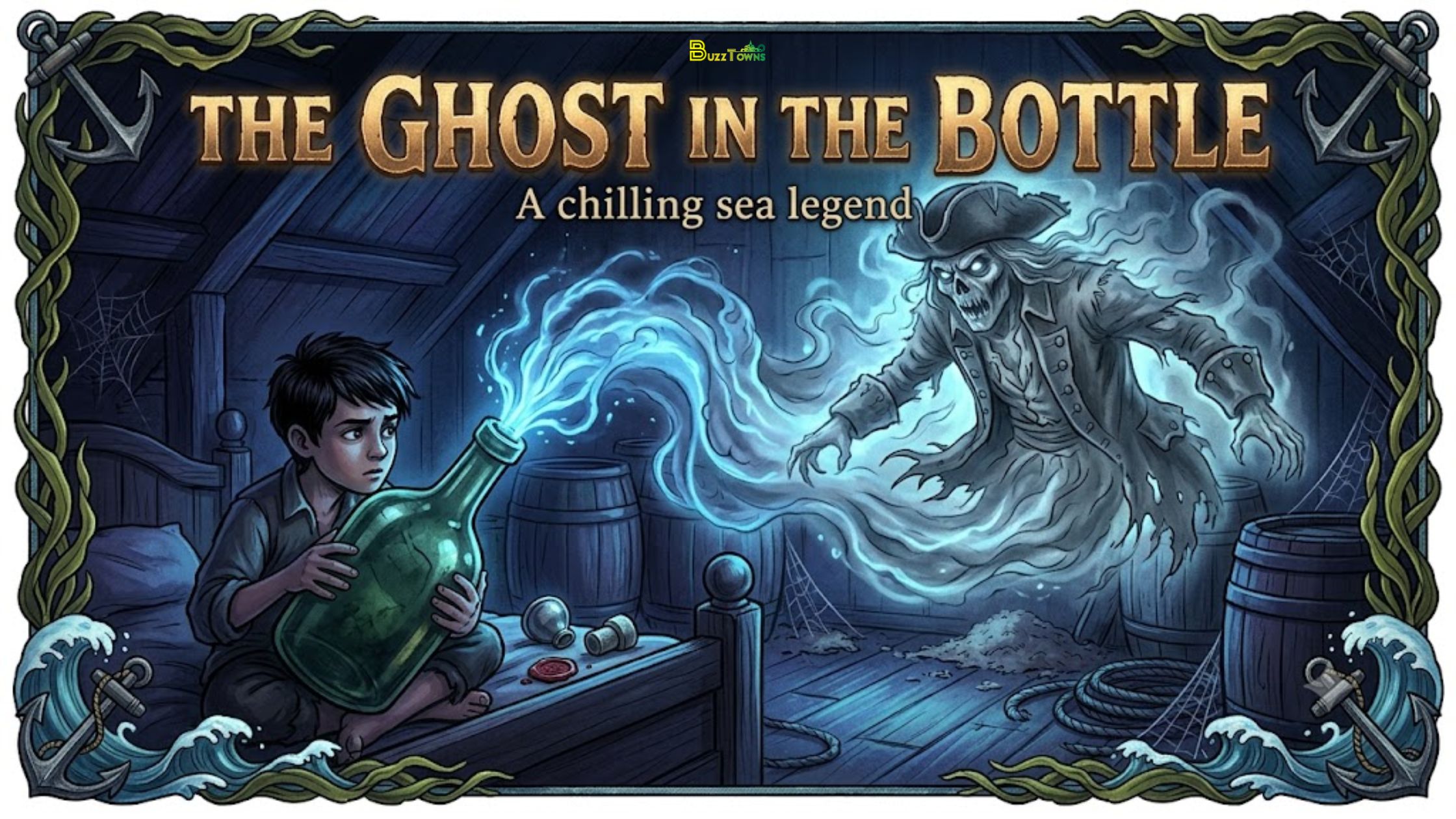
The sea around the jagged teeth of Oakhaven spit was notorious for taking things, not giving them back. Yet on an overcast Tuesday when the tide retreated like drawn breath, it left behind a thick cylinder of murky sea-glass nestled in the black sand.
Milo was fourteen, thin-wristed, and possessed of that restless curiosity that usually got a boy’s ears boxed by the village harbourmaster. He spotted the glint from fifty yards out.
The glass was dark olive, thick as a bull’s horn, its surface frosted by decades of sand-scour. It was plugged with a heavy pewter stopper, crimped down and sealed with dark red wax stamped with a sigil worn down by waves. When Milo picked it up, it was neither buoyant nor hollow. It felt unexpectedly heavy, cold enough to bite through the raw wool of his fingerless gloves.
He carried it home to his uncle’s cooperage, waiting until the rhythmic thud of the mallet ceased and the lanterns were snuffed out for the night. In the loft above the sawdust bins, under the drafty eaves, Milo sat cross-legged with an oyster shucker and a candle stub.
He chipped at the wax. It came away in brittle flakes that smelled faintly of cinnamon and old rot. He pried the pewter stopper, bracing his heels against the low bedframe. With a dull, sucking pop, the seal yielded.
A rush of cold air rushed out, carrying an impossible vacuum that caused the candle flame to bend double and gutter out.
Milo froze in the pitch dark, the empty shell of the bottle resting between his knees.
The silence did not belong to the room. It swallowed the rustle of straw, the whistling coastal gale, the creak of the roof beams. Then, the dark in front of him began to congeal.
It was not smoke, nor light, but a sudden density in the shadow, swirling like milk dropped in still water. Two pale spots opened within the gray, unblinking and silver-white as dead herring. A voice spoke, thin and rattling, like dry leaves scuttling across a tombstone.
“Seven centuries beneath the silt,” the voice whispered. “Who has drawn the cork?”
Milo’s tongue felt dry as salt. “Milo. Just Milo.”
The apparition drew itself up, elongating until its vaporous shoulders brushed the cobwebs between the rafters. It had the suggestion of an old sailor’s frock, ragged and sea-chewed, draped over limbs made of swirling mist and pale phosphorescence.
“A mortal boy,” the spirit murmured, its silver eyes tracking the boy’s rapid pulse in his neck. “A trembling scrap of clay. By the old covenants, the one who delivers a spirit from salt-iron bonds may claim three compensations before the soul takes its vengeance on the world.”
Milo had heard tales told by the drunkards down at the gull-dock. Djinn, barghests, drowned men wrapped in sea-kelp. “Three wishes?”
“Name them not wishes,” the ghost hissed, its form rippling with sudden venom. “They are debts. Blood-debts, boy. Ask for gold, and you rob another’s vault. Ask for power, and a throne must fall. Speak quickly, before I grow tired of your breath.”
Milo looked at the ghost, then down at the bottle. It was an ancient thing, but the glass was uncracked. He remembered his mother, who had died when he was six, worn hollow by the damp salt air and the butcher’s endless ledgers. He remembered his uncle’s bent spine, the bruised knuckles, the way men bowed their heads to the landlord who rode through town twice a season to collect what little copper they scraped from the shoals.
“My uncle,” Milo said slowly. “His hip is ruined from the adze. Fix his leg so he doesn’t limp.”
The ghost grinned, showing teeth like split sea-shells. “Done.”
A pulse of frost shot across the floorboards. From below, in the ground floor bedroom, a sharp gasp echoed, followed by a startled, shuffling thud. Feet hit the floorboards—two steady, unhindered steps. Then a laugh, cracked and bewildered.
The ghost loomed closer, its form swelling, filling the attic until the temperature plummeted so low that Milo’s breath fell in thick clouds.
“One debt paid,” the ghost croaked, its voice gaining volume, vibrating with deep, predatory power. “The second, boy! Demand your crown! Demand the woman you lust for! Demand the blood of your enemies!”
Milo watched the creature closely. It was expanding. Each second outside the glass seemed to knit its vaporous flesh tighter, giving it edges, weight, claws.
“Why were you in the bottle?” Milo asked.
“Demand!” the ghost roared, the sound rattling the copper nails in the eaves. “Do not question the storm, boy! The second debt!”
“I want to know why you were sealed,” Milo repeated, steadying his hands on his knees. “That is my second debt. Tell me your true name and the crime that put you in the dark.”
The silver eyes flared with furious violet fire. A wailing wind tore through the loft, spinning sawdust into a stinging vortex.
“I am Vane!” the phantom shrieked, the rafters groaning under the pressure of its fury. “Captain of the Black Hyssop! I drowned three hundred souls in the Sundering Reach to pay the sea-witch for an immortal lung! I took the silver from the chapel altars of seven coasts! The mages bound me to glass and iron, swearing I should churn in the shoals until the stars burned black!”
The ghost leaned down until its face, dreadful and half-decayed, hovered inches from Milo’s cheek. The smell of cold brine and old iron filled the boy’s nostrils.
“Now I am free, child. You have burned two debts on an old man’s bone and an old man’s history. Name the third. Name it, so the seal is severed forever and I may feast upon this valley.”
Milo looked at the raging spirit. He knew the stories of greedy fools who asked for kingdoms only to be buried alive in them. He knew that any man who bargained with a monster always paid with his own throat.
He gripped the bottle by its neck, bringing it up between them.
“For my third debt,” Milo said, his voice quiet, clear, and steady. “I command you to show me how a spirit of such tremendous size could ever fit inside such a tiny glass neck.”
The ghost paused, its rage suddenly tangled in ancient, haughty pride.
“Fool,” Vane sneered, his laughter rolling like thunder over the surf. “You think spirit is bound by your meat-flesh dimensions? We are smoke! We are will! We are the void itself!”
The spectral mass twisted violently, folding into a ribbon of blinding blue luminescence. With a hiss of triumphant vanity, the ribbon poured like molten lead straight down into the narrow mouth of the jar.
“See, boy?” a muffled voice rattled from deep inside the glass, vibrating against the dark green walls. “We are infinite! We are—”
Milo jammed the pewter stopper into the throat of the bottle and slammed it against the hardwood floor with the heel of his boot.
The vacuum inside caught the stopper with a hard, wet clack.
A high, thin screech of fury vibrated against the sea-glass. The bottle bucked in Milo’s hands, frantic and icy, trying to leap from his grip, but the pewter held fast.
He didn’t waste a second. Milo grabbed the oyster shucker, heated the blade in the ember of his stove, and melted the remnants of the red wax back over the rim, sealing the crevice until the stopper was smothered in fresh, hard gum.
The shivering in the glass stopped. It went cold, dead, and heavy once more.
Milo sat in the dim stillness for a long time, watching the morning light begin to leak gray and pale through the attic cracks. Down below, he could hear his uncle whistling an old sea shanty, his boots thumping firmly, evenly across the sawdust floor.
Milo took the heavy glass bottle, tucked it beneath his canvas coat, and walked down the hill to the harbour. He bypassed the village docks, the fish-gutting tables, and the shallows where children played. He walked out to the very end of the high headland, where the cliffs plunged into the deep, churning gray surf that never gave back what it took.
With both arms, Milo hurled the bottle as hard as he could, watching it arc against the pale sky before vanishing into the endless foam below.