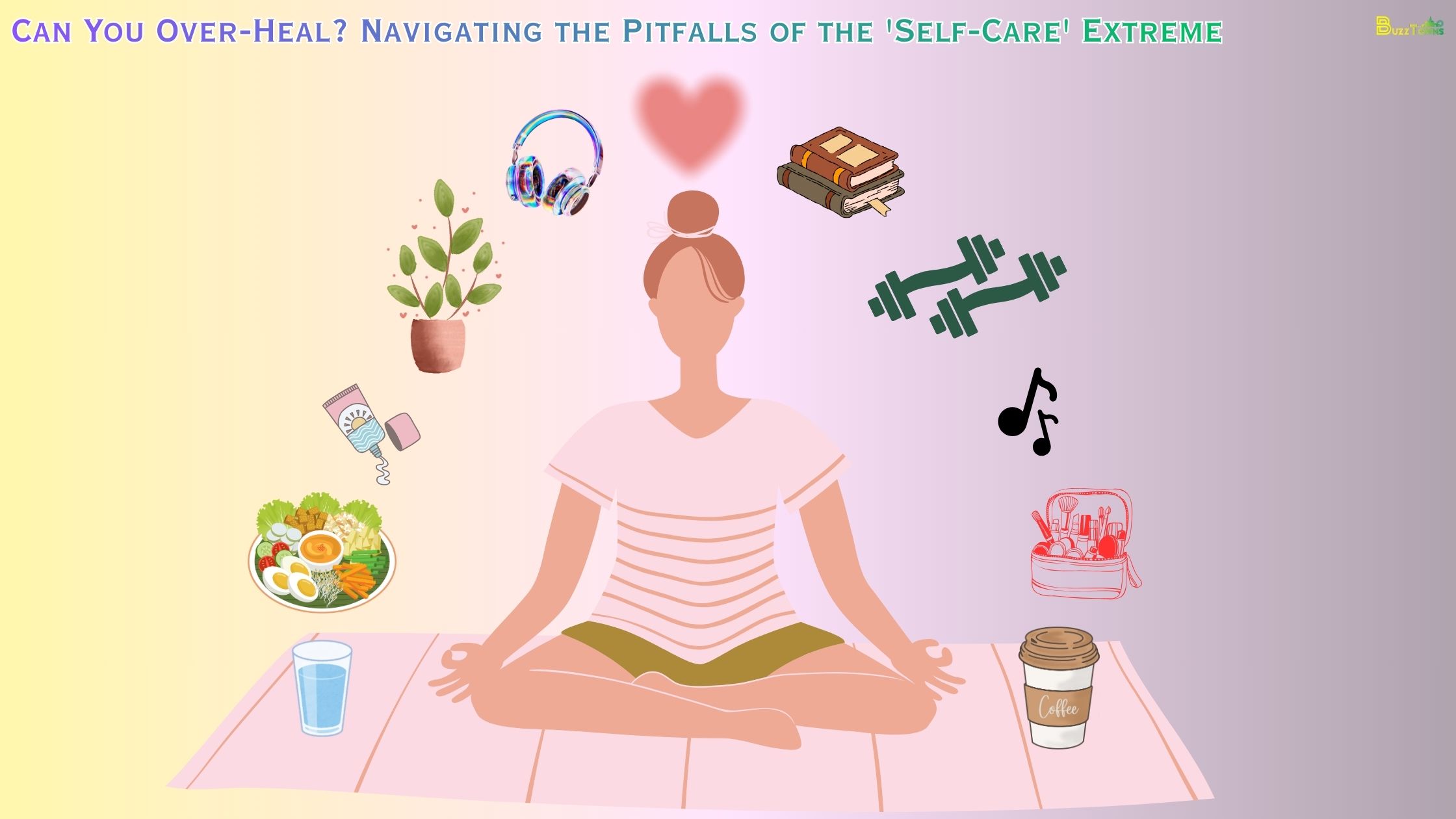
In today’s fast-paced, high-stress world, the concept of self-care has moved from a niche wellness trend to an important cultural mandate. We are constantly reminded to prioritize our mental health, set boundaries, and engage in practices that nourish our mind, body, and spirit. This widespread acceptance is an important step forward in countering the historical culture of “rush at all costs” and exhaustion.
Yet, like any powerful movement, the pursuit of healing and self-optimization can sometimes reach extremes – an area we might call “over-treatment.”
This is not about actual self-improvement or criticism of therapy; It’s about examining the shadow side of the wellness industry when the pursuit of perfection, constant introspection, and the identity associated with being a healer or being healed becomes the very thing that keeps us from living full, messy, and authentically human lives.
This detailed exploration sheds light on the concept of over-healing, identifies its symptoms, psychological underpinnings, and provides a path to balanced self-care.
The Rise of the ‘Self-Care’ Industrial Complex
To understand over-healing, we first have to look at the scenario from which it emerges. The wellness market is a multi-trillion-dollar industry. Healing is no longer just an individual journey; It is a consumable identity.
- The commodification of suffering: Every discomfort, every boundary crossed, and every personal weakness can be labeled, distorted, and treated with a corresponding product, workshop, or guru. The subtle message becomes: “If you’re still struggling, you’re not doing the right thing, or you’re not doing enough.”
- Pressure to perform well: social media creates a streamlined, competitive environment. Self-care routines are documented – exquisite sunrise yoga, 10-step skin care rituals, beautifully illuminated insights. This turns self-care from a private necessity into a public display, creating internal pressure to prove one’s “healthiness.”
When self-care is driven by external validation or internal pressure to achieve a perfect, conflict-free state, it ceases to be restorative and becomes a new form of stressful labor.
The Symptoms of Over-Healing
Over-healing appears when tools designed for liberation become tools of a new imprisonment. Here are the major psychological and behavioral red flags:
1. Analysis Paralysis and Excessive Introspection
Healing requires looking inward, but over-healing involves constant, unrelenting analysis. Every minor reaction, every small disagreement, and every fleeting negative thought is immediately picked apart, distorted, and attributed to a deeper trauma or core wound.
- The “Why” Trap: Instead of accepting a bad day as simply a bad day, the person enters a cycle: “Why did I feel irritable? Was it my childhood attachment style? Is it a sign of my repressed anger? What boundaries did I fail to set?” This cycle simply prevents emotions from happening and being felt, and instead forces the person into an exhausting, endless checking mode.
- Loss of intuition: When you’re constantly consulting a framework (e.g., attachment theory, Enneagram, specific self-help models), you stop trusting your own gut.
2. The Weaponization of Boundaries and Emotional Jargon
Boundaries are necessary for healthy relationships, but in over-healing, they can be deployed as walls for emotional isolation.
- Purge mentality: Relationships are perceived as binary: either “aligned” and “healing” or “toxic” and requiring immediate, often dramatic, removal. This lack of nuance prevents the practice of healthy relational friction, forgiveness, and dealing with minor conflicts – the same mechanisms that deepen adult relationships.
- Jargon as a shield: Terms like “gaslighting,” “narcissism,” “triggered,” and “energy vampire” are used liberally, often inaccurately, to label and dismiss anyone who challenges or causes discomfort. This shifts the focus from managing one’s own emotional response to labeling and controlling the behavior of others.
3. Perfectionism in the Pursuit of ‘Zero Trauma.’
The most insidious danger of over-healing is the implicit assumption that a fully healed person is a person who never suffers, never fails, and never experiences negative emotions.
- Emotional invalidation (self-induced): When a negative emotion comes up, the over-healer’s first thought is, “I should be over this by now. My self-help isn’t working.” This meta-shame (shame about feeling shame) invalidates the real, ongoing human experience of pain and difficulty.
- Avoidance of life: Real life is messy. It involves risk, possible rejection, failure, and sadness. The over-healer may subconsciously narrow his or her life to prevent the possibility of new “traumas” or “triggers”—avoiding new opportunities, deep intimacy, or demanding careers. The search for psychological security ultimately leads to a psychologically short life.
The Psychology Behind the Extreme
Why do people fall into the trap of over-healing? The answer lies in the desire for control and certainty in an often-chaotic world.
A. The Illusion of Mastery (The “Healed” Ego)
For anyone who felt powerless in their past—perhaps because of a difficult childhood or some major life crisis—the language of healing and self-mastery offers a powerful antidote. By classifying, naming, and analyzing their wounds, they gain intellectual mastery over their history.
- The “Healed Ego” belief: “If I know all the laws of psychology, I can never get hurt again.” It is an attempt to use knowledge as a fort rather than a map for navigation. When life inevitably breaks this fortress, the feeling of failure is devastating, leading to even more desperate “self-action.”
B. Spiritual Bypassing
It is a well-documented psychological phenomenon where people use spiritual practices, psychological frameworks, or “positive affirmations” to avoid confronting unresolved emotional wounds, psychological needs, or difficult tasks.
Instead of confronting conflict with a family member, the over-healer may say, “I need to protect my peace and raise my vibration,” thereby bypassing the hard, dirty work of honest communication and relational accountability. It uses the language of self-awareness to justify emotional abstinence.
Navigating Back to Balanced Self-Care
The goal is not to stop treatment; It’s about reorienting the process from outcome-driven obsession to process-driven practice that allows for real, imperfect living.
1. Embrace the Messy Middle: Functional Imperfection
The key change is to recognize that treatment is not a destination; It is your ability to function well despite your imperfections and past wounds.
- The 80/20 Rule: You don’t need to be 100% “fine” to pursue a loving relationship or a challenging career. Aim for functional incompleteness. Are you generally kind? Are you fulfilling your responsibilities? Can you repair a relational rift? If so, you are “sufficiently recovered.”
- Action on Analysis: When you feel trapped in the analysis trap, ask: “What is the next concrete, real-world action I can take, regardless of which ‘core wound’ it is?” Sometimes, the most therapeutic thing you can do is simply wash the dishes, call a friend, or start that project you’ve been putting off.
2. Re-Contextualize Negative Emotions
Stop seeing negative emotions (anger, sadness, fear) as evidence of a failed treatment journey and start seeing them as functional data points.
- Anger: Not a sign of repressed trauma, but often a signal that a value is being violated or that some action needs to be taken.
- Anxiety: Not evidence of an attachment problem, but often a signal to the nervous system that a transition is occurring or that moderate planning is needed for a future problem.
- Test of Resilience: The true measure of healing is not how few triggers you have, but how quickly and effectively you can recover when a trigger occurs.
3. Shift from ‘Me’ Focus to ‘We’ Focus
The extreme of self-care is inherently individualistic. Paradoxically, balanced self-care involves radical connection.
- Service and Contribution: Nothing moves a person forward faster than getting attention for contributing to something bigger than themselves. Volunteering, mentoring, or simply being a supportive friend takes the focus off the self-project and focuses it on the world community.
- Relational Accountability: Commit to the dirty work of being in a relationship. Practice saying, “I messed up, and I take responsibility for my part,” instead of, “I was provoked by a childhood wound, and you need to respect my boundaries.”
🔑 Conclusion: Healing to Live, Not Living to Heal
The ultimate goal of healing is not to become a Buddha on some mountain top free of all human struggles. The ultimate goal is to become an active, engaged participant in your life.
Over-healing is an attempt to clean up the playing field so thoroughly that you never have to play the game again.
True, balanced self-care is the process of building a strong, resilient container—a nervous system, a community, and a resilient mindset—that can accommodate the inevitable joys and inevitable pain of being alive. It allows us to step away from the mirror of introspection and look outward, ready to engage with the complex, imperfect, and fantastic world out there. The work never ends, and that’s the beautiful, liberating truth of it. Live your life, flaws and all.