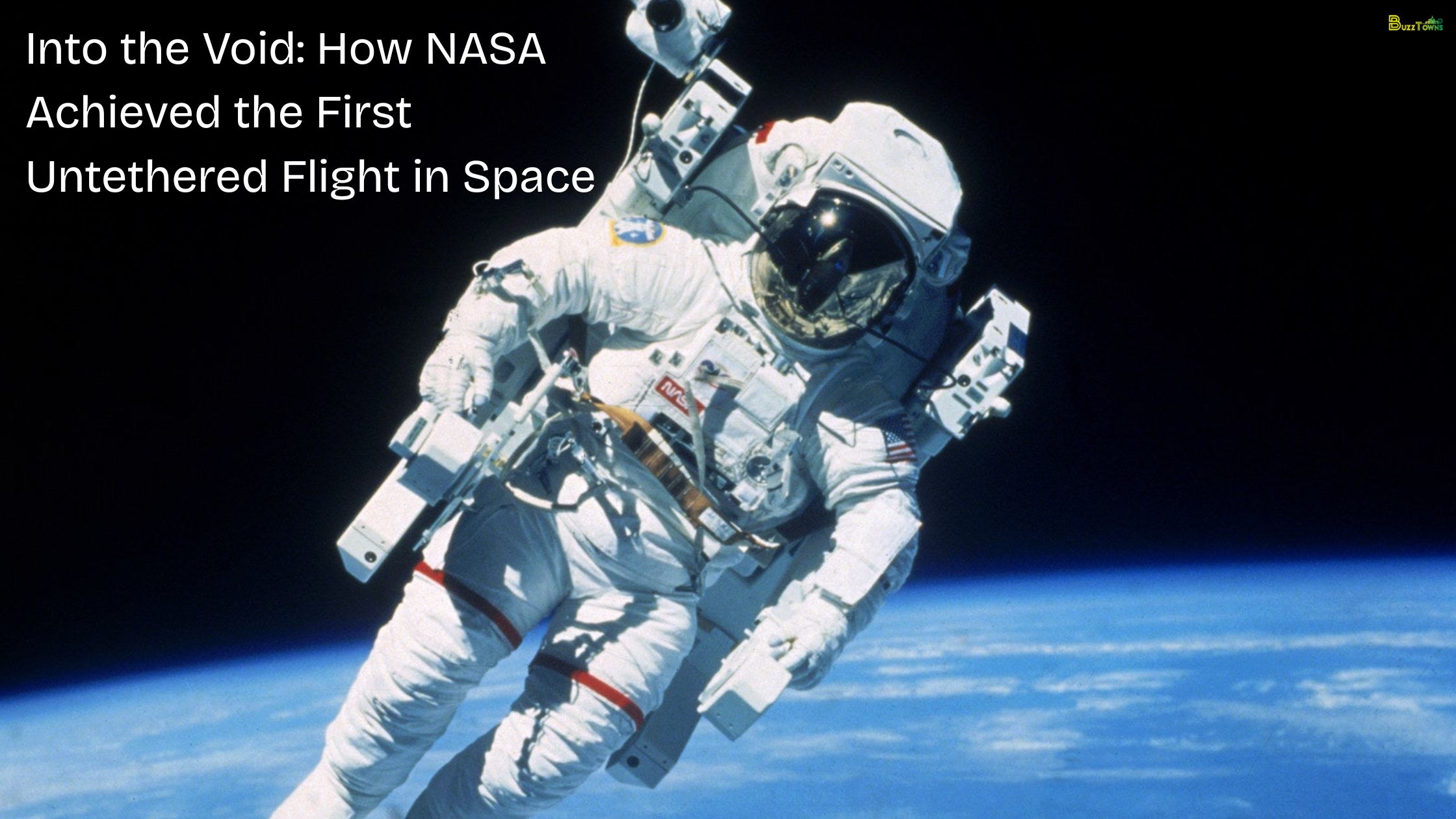
When examining the timeline of human exploration, there are a few photographic moments that permanently alter our understanding of what is possible. We have the Wright Brothers at Kitty Hawk, Neil Armstrong leaving a boot print in the lunar dust, and then, there is the chillingly beautiful image of an astronaut floating completely alone in the endless black vacuum of space, suspended high above the curvature of the Earth. This iconic moment occurred on February 7, 1984, during the STS-41 B mission of the Space Shuttle Challenger. On this day, astronaut Bruce McCandless II stepped out of the payload bay and drifted away from his ship without a lifeline, executing the First Untethered Flight in Space.
Here at Techeest, we constantly explore the intersection of human courage and cutting-edge engineering. The story of how NASA achieved this remarkable milestone is a masterclass in both. It required decades of technological development, an unprecedented leap in aerospace hardware, and an astronaut willing to conquer the ultimate psychological abyss.
The Problem with Lifelines
Before 1984, every single Extravehicular Activity (EVA)—commonly known as a spacewalk—was conducted using a physical tether. From Soviet cosmonaut Alexey Leonov’s terrifying first spacewalk in 1965 to the Apollo missions, astronauts were always physically connected to their life support systems or their spacecraft via braided steel and Kevlar umbilical cords.
While tethers provided an undeniable psychological and physical safety net, they were incredibly restrictive.
- Tangle Hazards: In the zero-gravity environment of orbit, long cords easily became tangled around antennas, solar panels, and the astronauts themselves.
- Limited Range: An astronaut could only work as far as their cord would stretch, making remote repairs on large orbital structures nearly impossible.
- Mobility Restrictions: The stiffness of the pressurized suits, combined with the drag of a heavy umbilical cord, made intricate movements exhausting.
NASA engineers realized that to build space stations and capture free-flying satellites, astronauts needed to become autonomous, maneuverable spacecraft themselves. They needed to sever the cord.
The Engineering Marvel: The Manned Maneuvering Unit (MMU)
The solution to the tether problem was a piece of hardware that looked like it was pulled straight from the pages of a science fiction novel: the Manned Maneuvering Unit (MMU). Developed in a joint venture between NASA and Martin Marietta, the MMU was a massive, 300-pound (136 kg) nitrogen-propelled jetpack designed to snap onto the back of a standard Extravehicular Mobility Unit (EMU) spacesuit.
To ensure the First Untethered Flight in Space would not end in tragedy, the MMU was designed with extreme redundancy. It featured:
- Twin Propellant Tanks: Two aluminum tanks containing high-pressure nitrogen gas.
- 24 Micro-Thrusters: Placed at various angles across the unit to provide six-degrees-of-freedom flight (pitch, yaw, roll, and direct translation in any direction).
- Armrest Controllers: The astronaut operated the MMU using two joysticks mounted on the armrests. The right hand controlled rotational movement, while the left hand controlled forward, backward, and lateral movement.
- Automatic Attitude Hold: A gyroscopic system that could automatically fire thrusters to hold the astronaut completely steady, allowing them to use both hands to repair a satellite.
Despite its bulky appearance, the MMU was incredibly precise, capable of moving at a gentle, controlled pace of about 0.2 to 0.3 feet per second.
The Psychological Abyss
Engineering the hardware was only half the battle. Stepping out of a spacecraft flying at 17,500 miles per hour, 170 miles above the Earth, with absolutely no physical connection to safety required an almost superhuman level of psychological discipline.
If McCandless were to panic, overcorrect his joystick inputs, or experience a total system failure, there was no tether to pull him back. He would simply drift off into the deadly vacuum of the cosmos. To prepare, McCandless spent hundreds of hours inside simulators, building the muscle memory and cognitive focus necessary to tune out the overwhelming sensory experience of the void and focus entirely on the micro-movements of his fingertips.
The Historic Spacewalk: February 7, 1984
When the cargo bay doors of the Challenger opened on that historic Tuesday, the tension in Mission Control was palpable. McCandless floated to the rear of the bay, backed into the MMU station, and locked the life-support systems into place.
After completing his final checks, he activated the nitrogen thrusters. He slowly backed away from the shuttle. As he drifted further into the blackness, severing the final earthly bond, he broke the tense silence over the radio loop with a nod to Neil Armstrong:
“It may have been one small step for Neil, but it’s a heck of a big leap for me.”
During this First Untethered Flight in Space, McCandless traveled an astonishing 320 feet (about 98 meters) away from the Challenger. For 45 minutes, he was a completely independent human satellite. He tested the maneuverability of the jetpack, executing precision rolls and stops. The system performed flawlessly. Later in the same spacewalk, his crewmate Robert Stewart also donned the MMU and took his own flight into the void.
A Legacy of Innovation and Caution
The MMU was hailed as a massive success. It was used on two subsequent space shuttle missions (STS-41-C and STS-51-A) to successfully capture and retrieve broken satellites (Solar Max, Palapa B2, and Westar VI) and bring them back into the shuttle’s payload bay for repair.
However, the era of the MMU was short-lived. Following the tragic Challenger disaster in 1986, NASA completely overhauled its safety protocols.
The Evolution of Spacewalk Technology
| Technology | Era | Primary Function | Tether Status |
| Umbilical Systems | 1960s – 1980s | Provided oxygen, comms, and safety. | Fully Tethered |
| The MMU | 1984 | Enabled independent satellite retrieval and complex maneuvers. | Untethered |
| SAFER System | 1994 – Present | Emergency self-rescue jetpack worn on the ISS. | Tethered (Unless emergency) |
The agency determined that while the MMU was a brilliant piece of technology, an untethered spacewalk carried an inherent and unnecessary level of risk. The protocols were changed: shuttles and space stations would use robotic arms to grab satellites and bring them to the astronauts, rather than sending astronauts flying across the void.
Today, the legacy of the MMU survives in the form of SAFER (Simplified Aid For EVA Rescue). This is a much smaller, emergency-only jetpack worn by astronauts on the International Space Station. It is designed to be used only in a catastrophic scenario where an astronaut’s tether snaps, providing them with just enough nitrogen thrust to fly back to the airlock.
Final Thoughts
The photograph of Bruce McCandless floating against the backdrop of the Earth remains one of the most widely reproduced and awe-inspiring images in the history of science. The First Untethered Flight in Space proved that humanity could conquer not just the physical challenges of the cosmos, but the psychological ones as well. It stands as a permanent testament to the power of human ingenuity, bold engineering, and the endless desire to explore the unknown.