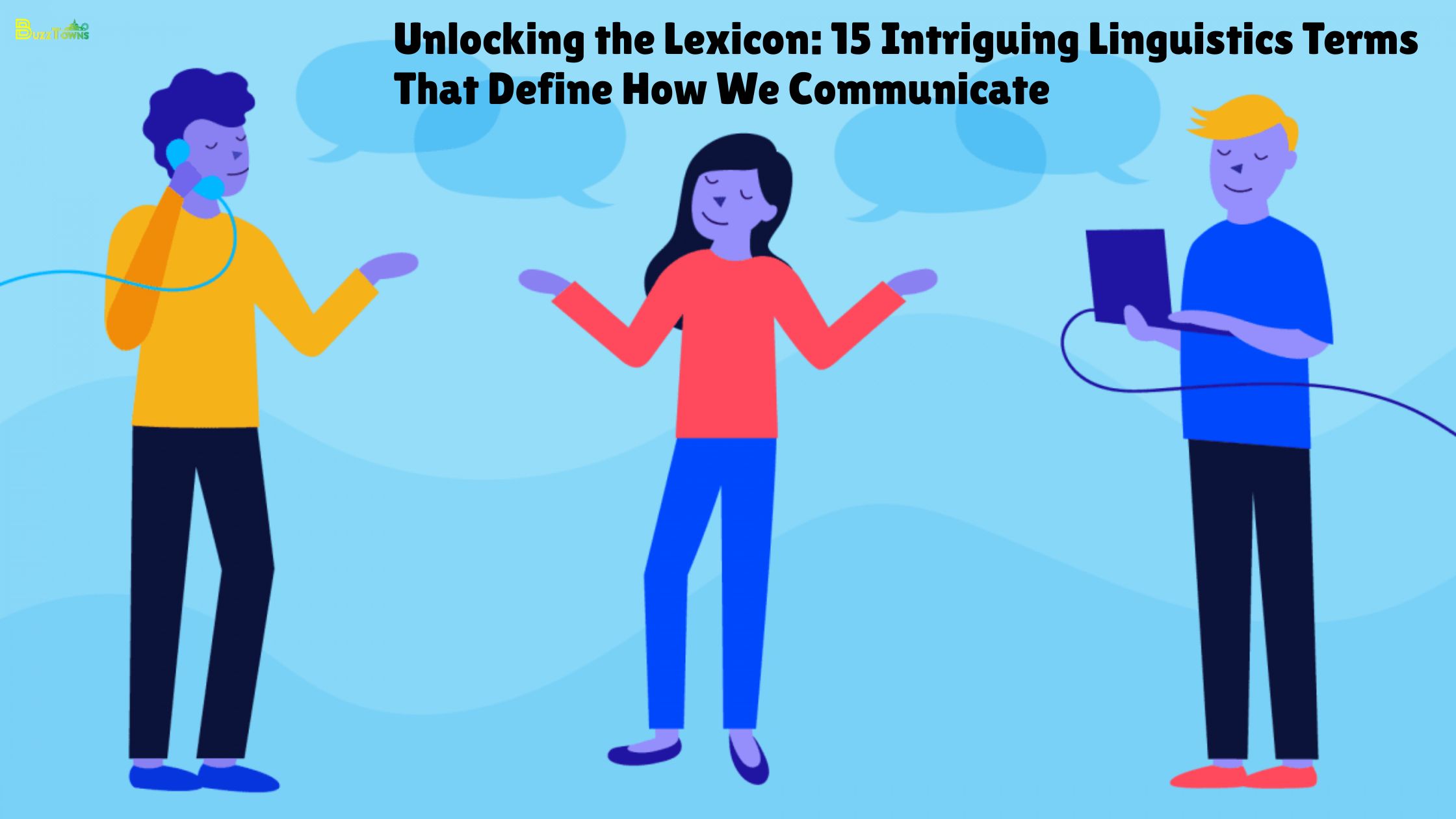
Language is the invisible architecture of our daily lives. We use it constantly—to persuade, to comfort, to joke, and to express our deepest thoughts—yet we rarely pause to consider the mechanics operating behind the scenes. Behind every slip of the tongue, every misheard lyric, and every perfectly timed punchline, there is a complex framework of rules and phenomena. By pulling back the curtain and exploring these intriguing Linguistics Terms, we can gain a much deeper appreciation for the quirks, flaws, and brilliant adaptability of human communication. Whether you are a dedicated word nerd or simply curious about why we speak the way we do, here are 15 fascinating linguistic concepts that define how we communicate.
The Phenomena of Everyday Speech
We experience these linguistic quirks daily, often without having a name for them.
1. Semantic Satiation
Have you ever repeated a word so many times that it completely loses its meaning and dissolves into a bizarre series of sounds? That psychological phenomenon is called semantic satiation. When you say the word “bowl” twenty times in a row, your brain’s neural pathways become temporarily fatigued. The connection between the sound and the concept is momentarily severed, leaving you babbling what feels like alien gibberish.
2. Contronym
A contronym (sometimes called a Janus word, after the two-faced Roman god) is a word that is its own opposite. The context dictates which meaning is being used. For example, to “dust” a cake means to add a fine layer of sugar to it, but to “dust” a living room means to remove a fine layer of dirt. Similarly, “sanction” can mean to approve something or to penalize it.
3. Mondegreen
If you have ever belted out “Excuse me while I kiss this guy” instead of Jimi Hendrix’s actual lyric, “Excuse me while I kiss the sky,” you are a victim of a mondegreen. Coined by American writer Sylvia Wright—who misheard the Scottish ballad lyric “laid him on the green” as “Lady Mondegreen”—this term refers to the mishearing of a phrase in a way that creates a new, often hilarious, meaning.
4. Eggcorn
Closely related to the mondegreen is the eggcorn. This occurs when someone mishears a word or phrase, but their incorrect version actually makes logical sense. The term comes from someone mishearing the word “acorn” as “eggcorn” (which, functionally, is a seed shaped like an egg). Other common eggcorns include saying “nip it in the butt” instead of “bud,” or “duck tape” instead of “duct tape.”
5. Spoonerism
A spoonerism is a speech error in which the initial consonants or syllables of two or more words are swapped. Named after the famously tongue-tied Reverend William Archibald Spooner, this phenomenon leads to brilliant accidental phrases. Instead of saying “the loving shepherd,” you might say “the shoving leopard.” Instead of “a crushing blow,” you might deliver “a blushing crow.”
The Mechanics of Meaning
How do words actually convey what we want them to say? These terms explore the structural side of our vocabulary.
6. Code-Switching
Originally used to describe multilingual people who switch between two or more languages in a single conversation, code-switching now also refers to the way we adapt our dialect, tone, and vocabulary based on our social setting. You do not speak to your boss the same way you speak to your best friend, and you do not speak to a toddler the way you speak to a barista. We all seamlessly code-switch to navigate different social dynamics.
7. Pragmatics
Pragmatics is the branch of linguistics that studies how context contributes to meaning. It is the difference between the literal meaning of a sentence and what the speaker actually intends. If you are sitting at a dinner table and someone asks, “Can you pass the salt?” pragmatics dictates that they are not asking about your physical ability to lift the shaker; they are making a polite request for you to hand it to them.
8. Back-Formation
Language is highly adaptable, and sometimes we create new words by mistakenly assuming an existing word has a suffix, and then chopping it off. This is called back-formation. For example, the noun “burglar” existed long before the verb “burgle.” English speakers assumed “burglar” was a person who burgles, and a new verb was born. The same process gave us “edit” (from editor) and “pea” (from pease).
9. Portmanteau
A portmanteau is a linguistic blend of words, where parts of multiple words are combined into a new word that encapsulates both meanings. “Smog” (smoke + fog), “brunch” (breakfast + lunch), and “motel” (motor + hotel) are classic examples. It is a highly efficient way for language to evolve and describe new cultural phenomena.
10. Lexical Gap
Also known as a lacuna, a lexical gap is an instance where a language completely lacks a specific word to describe a concept that exists. This is why English frequently borrows heavily from other languages. We do not have a native English word for the joy derived from someone else’s misfortune, so we use the German Schadenfreude.
The Quirks of Vocabulary
Sometimes, the words themselves have a sense of humor.
11. Aptronym
An aptronym is a person’s name that is amusingly appropriate for their occupation or character. Think of the fastest man in the world, Usain Bolt, or the famous British poet, William Wordsworth. When a name perfectly aligns with a person’s life path, linguistics gives us a delightful term to categorize it.
12. Malapropism
Named after the character Mrs. Malaprop in Richard Brinsley Sheridan’s 1775 play The Rivals, a malapropism is the mistaken use of a word in place of a similar-sounding one, often with unintentionally amusing results. Saying that you want to “dance a flamingo” instead of a “flamenco,” or claiming that someone is “a figment of your imagination” instead of a “figment,” are classic malapropisms.
13. Hypercorrection
This happens when someone tries so hard to speak “properly” that they actually apply a grammatical rule incorrectly. A common example is using “I” instead of “me” in an attempt to sound sophisticated. People often say “between you and I,” assuming it sounds more formal, when the grammatically correct phrase is actually “between you and me” (since the pronouns are objects of the preposition).
14. Tautology
A tautology is the repetitive use of phrases or words that have similar meanings. While it is often considered a stylistic fault, we use tautologies in everyday speech all the time. Saying “gift” (a gift is inherently free), “ATM” (Automated Teller Machine), or “bonus” are all examples of tautological redundancy.
15. Diglossia
Diglossia refers to a situation where two distinct varieties of a language are used by a single language community, but under very different conditions. One variety is used in formal, written, or academic contexts, while the other is used for everyday, informal conversation. Arabic is a prime example, where Modern Standard Arabic is used in news and literature, but distinct regional dialects are spoken in homes and on the streets.
The Living Lexicon
Language is never static. It is a living, breathing entity that shifts and bends to accommodate the people who use it. By understanding the terminology behind these shifts—from the humorous mistakes of spoonerisms to the psychological fatigue of semantic satiation—we become better, more observant communicators. The next time you catch yourself blending two words or mishearing a pop song, you will know exactly which linguistic phenomenon to blame.