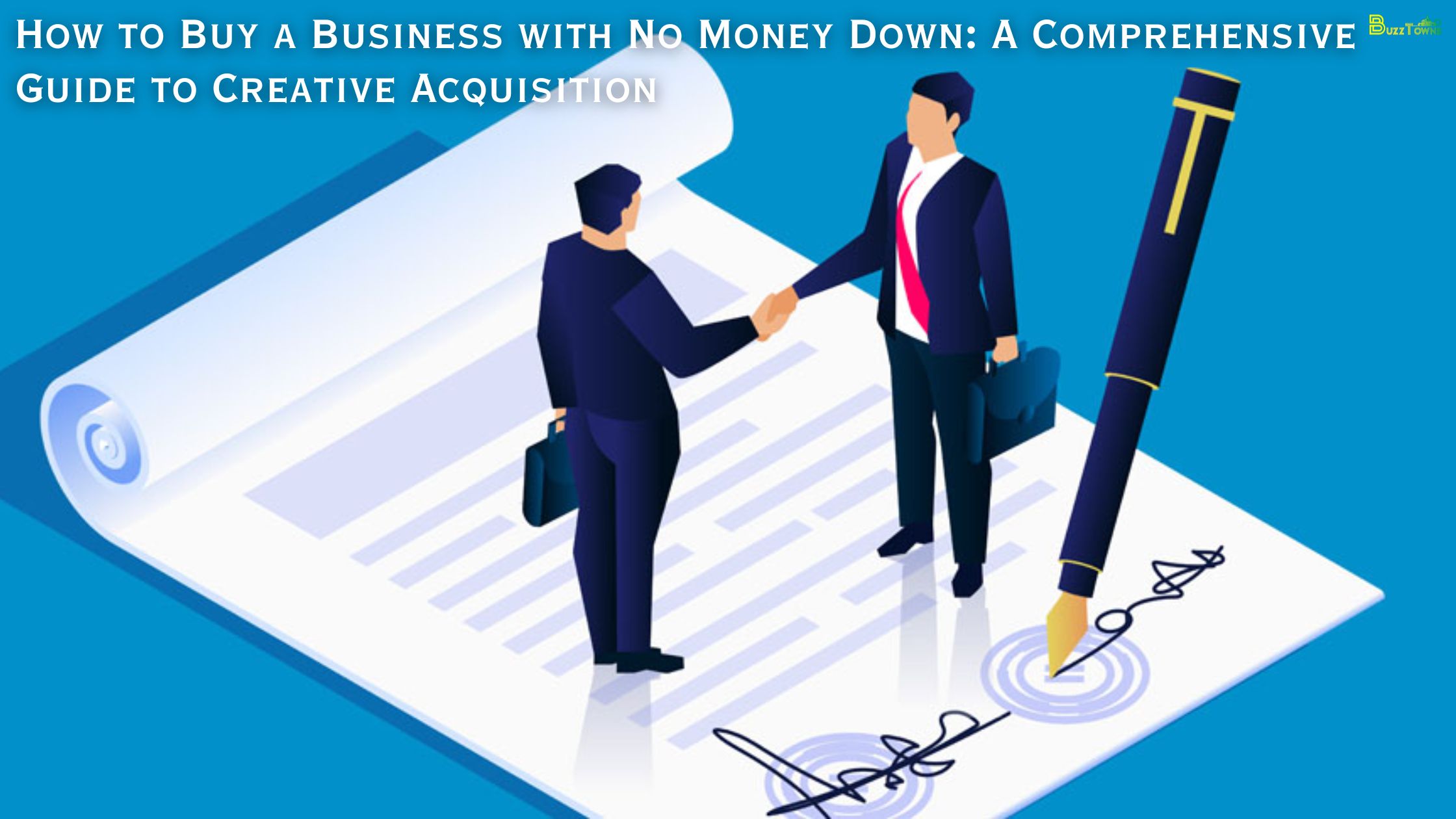
The dream of owning a business is powerful, but the traditional passage for acquisition often requires a significant amount of advanced capital. For many ambitious entrepreneurs, this barrier to entry may seem inaccessible. However, what if you can bypass the requirement of a large down payment and get a business using smart, creative strategies to buy a business with no money?
This is not an imagination. With the right knowledge and desire to think outside the box, you can buy a business completely without money. This detailed guide will run you through proven methods, financial structures, and strategic thinking, which are necessary to transform your entrepreneurial dream into a reality without dipping into your savings.
The Fundamental Shift: From Buyer to Value-Creator
The first step in this journey is mental. You have to transfer your mindset to an active price-maker by being an inactive buyer. Traditional business acquisition is often seen as a simple exchange of cash for assets. But when you have no money, your currency becomes your expertise, your vision, and your ability to improve the performance of your business.
Instead of focusing on the purchase price, you will focus on the capacity of the business for future cash flow and how you can use that ability to pay for an acquisition. This is the main principle behind almost every “no-money-down” deal.
1. The Power of Seller Financing
This is the most common and effective way to get a business, without a doubt, for those which has no money. Seller financing is a strategy where the current owner acts as a bank and lends money to buy a business.
How it works:
Instead of paying outright at the closing, you and the sellers agree on a payment plan over a fixed period (often 3 to 10 years). You will usually make a small payment, and the rest of the purchase price is paid with interest over time. The future cash flow of the business is a source of money to repay the loan.
Why do the sellers agree to this:
- Tax Benefits: Instead of paying at once, the seller can spread their capital gains tax liability over many years.
- High selling price: By offering financing, the seller opens his business to a broad pool of buyers, potentially allowing them to command a high selling price.
- Constant income: For a retired owner, it provides a stable stream of income for the coming years.
- Faith in the buyer: It indicates that the seller has faith in your ability to run and pay for the business.
Making it Work for You:
To convince a seller to finance the deal, you should show a strong understanding of the business and have a compelling plan to improve its performance. You briefly ask them to bet on you. You will need to prepare a detailed business plan that outlines:
- Your relevant experience and skills.
- A clear plan for how you will manage and grow your business.
- Realistic financial estimates that show how you will generate sufficient cash flow to cover the payment.
2. The Earn-Out: A Shared Risk, Shared Reward Model
Earnings are a creative payment structure that combines a part of the purchase price for the future performance of the business. It is an excellent tool to bridge an assessment interval between the buyer and the seller.
How it works:
Buyers and sellers agree on a base purchase price, with an additional “earning-out” payment which is accidental on the specific performance targets of the business meeting on a defined period (eg, 1-3 years). These goals are generally based on a major matrix such as revenue, gross profit, or Ebitda (income before interest, taxes, depreciation, and amortization).
Why is this “no-money-down” solution:
The earned part of the payment, according to the definition, is funded by the future success of the business. If the business performs well under your management, the seller gets a higher price, and you fund the payment with the profits you make. This reduces your upfront cash requirement and aligns the interests of both sides.
Practical Example:
Suppose a business value is $ 500,000, but the buyer has only $ 50,000 in cash available. Parties can structure a deal where:
- The seller pays $ 50,000 when the buyer is closed.
- The remaining $ 450,000 is a combination of seller financing and an earn-out.
- A part of the total price is paid by the company’s profits over the next two years, which is based on the revenue milestone. Buyers and sellers share the reward of risk and business post-acquisition performance.
3. The Leveraged Buyout (LBO) for Small Businesses
A company is acquired by using a significant amount to fund a leveraged buyout purchase. While the term is often associated with large private equity deals, principles can be applied to small business acquisitions.
How it works:
Buyer secures a loan to fund acquisitions, and the property and cash flow of the business being acquired are used as collateral for debt. The buyer’s down payment is minimal, and the loan is repaid over time using its operating cash flow.
Financing source for an LBO:
- SBA 7 (A) Loan: The Small Business Administration (SBA) does not lend money directly, but it guarantees a part of the loan made by banks and other lenders. This guarantee reduces the risk for the lender, making them more inclined to offer favorable conditions, including low down payments (often 10% to 20%). The loan payment is returned with business profits.
- Commercial bank loans: Some bank acquisitions provide loans, but they are often more rigid with their requirements, usually a high down payment and a strong personal financial history from the buyer.
- Tapping in Retirement Funds (ROBS): A “Rollovers as Business Startups” (ROBS) plan allows you to use money from a 401 (K) or other retirement account to buy a business without taxes or penalties. It is a complex legal structure that requires professional guidance, but may be a powerful way to reach vital capital without traditional debt.
Key to a successful LBO:
The business you get should have a strong, stable, and approximate cash flow. Lenders need to ensure that the business can generate sufficient benefits for the service to make loan payments. You will need to present a strong business plan and financial estimates that prove this ability.
4. The “Sweat Equity” and Partner Buy-In Approach
It is less about a traditional acquisition and more about a strategic partnership. It is a method for people with valuable skills but no capital.
How it works:
You identify the owner of a business who wants to retire but does not have a successor. You offer to work for them, potentially for a low salary or even for free, in exchange for a future equity stake in the company. Over time, you prove your value, learn business, and earn a position to handle yourself.
Conversation:
The agreement can be structured in many ways:
- Phaseted ownership: You earn a small percentage of ownership each year, with the option of purchasing the remaining equity after a certain period.
- Performance-based: Your ownership stake is associated with specific achievements, such as increasing revenue or profit margin.
- Partnership: You get a financial partner who brings cash to the table, while you bring “the equity of sweat” and operating expertise.
This strategy requires patience and belief, but it can be a spontaneous transition of ownership and a business that is already deeply familiar to you.
5. Finding an Underperforming Business
A struggling business can be an incredible opportunity for an entrepreneur with a new approach. These businesses can often be acquired for a very low price, and with no-money-down structures, as the current owner is motivated to get out and cut his losses.
The opportunity:
- Operating disability: You can buy a business that is poorly managed, has chronic technology, or lacks a strong marketing presence. Your job is to bring your expertise, fix problems, and unlock its hidden value.
- Appellate seller: A seller with a business who is bleeding is often more inclined to accept the creative financing system to get rid of the burden.
The challenge:
You need to be able to make an accurate diagnosis of problems and have a clear, working plan to turn on the business. It is a high-risk, high-ambition strategy that requires significant investment of your time and energy.
The Actionable Roadmap: A Step-by-Step Guide
- Define your goal: Instead of only looking for “a business”, find an industry that you are emotionally invested in and experience it. Look for businesses that fit the criteria for no-money-down deals: induced vendors, clear cash flows, or clear opportunities for improvement.
- Network tirelessly: Connect with business brokers, accountants, lawyers, and other entrepreneurs. Tell everyone that you meet that you want to buy a business. Many great opportunities are found through personal connections.
- Do proper work: Even though there’s no money on the line upfront, you need to be careful. Check financials, talk to employees and major customers, and understand the market. An intensive analysis will give you the confidence to interact and will be required to plan a compelling business.
- Craft a killer business plan: This is your currency. It should be professional, well-researched and confident. This clearly needs to clarify your vision, your strategy for improvement, and your ability to generate the cash flow required to pay for the acquisition.
- Propose the deal: Submit your proposal to the seller with confidence. Just don’t say, “I have no money.” Instead, “I have a plan to achieve your business using the seller’s financing and a combination of an earn-out,” says, “I have been paid for your future profits. This will benefit you …”
- Look for professional guidance: This is not a trip to take alone. Work with a lawyer who specializes in mergers and acquisitions and a financial advisor who understands alternative financing structures. They will help you navigate legal complications and structure a deal that protects your interests.
Buying a business without money is not about finding a magic flaw. This is about taking advantage of your skills, creativity, and strategic thinking to create a winning position for both you and the seller. It is about the vision to find the hidden value in a business and unlock it. The capital is not the one that takes you to the finish line – this is the strategy that takes you there.