
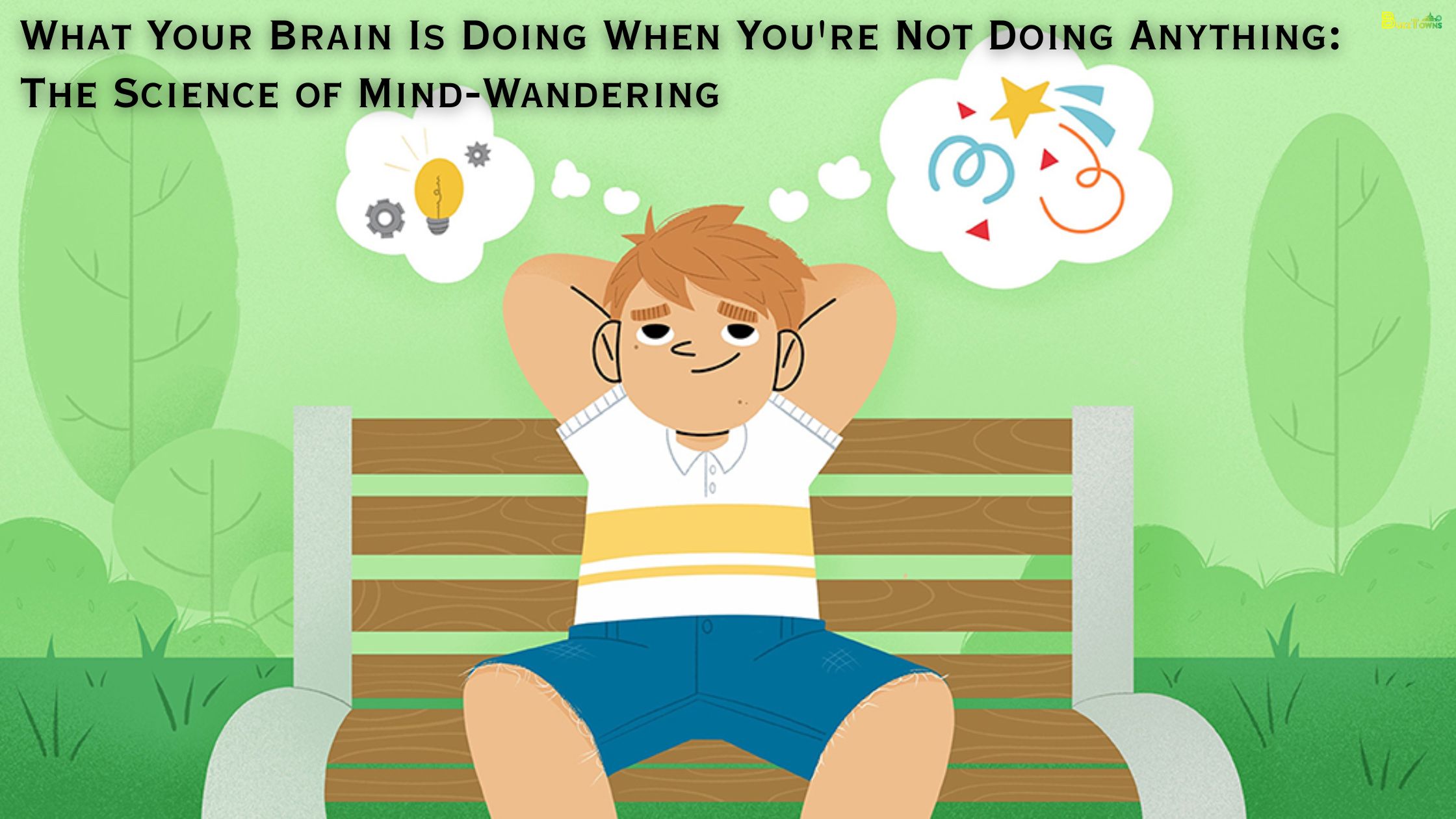
Mind-wandering, the quintessential human experience of taking one’s thoughts away from the current task and into the inner world of memories, fantasies, and plans, is nothing more than a passive state. Far from being a mere distraction, this ubiquitous mental phenomenon represents an important, highly active, and complex mode of brain function. It is this spontaneous, internal monologue that defines our conscious lives, occupying an estimated 30–50% of our waking hours. hour.
Scientific investigation of this seemingly innocuous activity has revealed a sophisticated neural architecture and profound evolutionary and psychological significance, fundamentally challenging the traditional view that the brain “turns on” only when performing an external task. The discovery and subsequent discovery of the default mode network (DMN) is one of the most significant breakthroughs in understanding what our brains are doing when we are doing nothing.
The Discovery of the Default Mode Network (DMN)
For decades, neuroscientists worked under the assumption that the brain’s basal state – the state it returns to during rest – involves a significant reduction in activity. Studies using functional magnetic resonance imaging (fMRI) and positron emission tomography (PET) typically focus on task-positive regions, assuming that the “rest” condition was a silent control condition.
The Serendipitous Finding
The concept of the default mode network emerged from a series of counterintuitive observations, notably by Marcus Raichle and colleagues in the early 2000s. They observed a consistent pattern: A specific set of brain regions repeatedly showed higher metabolic activity when subjects were simply resting (for example, staring at a fixation cross) than when they were actively engaged in a demanding cognitive task (for example, math problem solving or reaction-time To test.
This paradoxical increase in activity during the “resting” baseline suggested the existence of a highly organized, intrinsically active, and energy-consuming system that is activated by default – hence the name, default mode network. This discovery shifted the scientific paradigm from viewing rest as nervous calmness to viewing it as a state of structured, internal processing.
Anatomy and Core Components of the DMN
The DMN is not a single structure but a distributed, functionally interconnected network of brain areas that primarily includes:
- Posterior cingulate cortex (PCC)/precuneus: Often considered the main hub of the DMN and the most metabolically active region. This is considered important for integrating information across the network.
- Medial prefrontal cortex (mPFC): Involved in self-referential processing, assessing personal relevance, and evaluating future outcomes.
- Angular gyrus/temporoparietal junction (TPJ): Important for perspective taking, theory of mind (understanding the mental states of others), and episodic memory retrieval.
- Hippocampus and parahippocampal gyrus: important for memory formation and retrieval of past experiences, providing “material” for internal thought.
These areas, despite being spatially distant, show high levels of synchronized, low-frequency oscillations in their activity when the brain is at rest, suggesting continuous, coordinated communication.
The Functions of Mind-Wandering: The DMN in Action
Mind-wandering is now considered to be the subjective, conscious experience of the underlying neural computations of the DMN. It is the cognitive expression of the DMN’s default activity, and its functions are multifaceted, extending far beyond simple daydreaming.
1. Self-Referential Processing and Identity
The DMN is closely linked to self-perception. When the mind wanders, thoughts often revolve around personal experiences, characteristics, and beliefs. This process is called self-referential processing. Constant reflection on one’s personal narrative helps maintain a coherent, stable sense of identity over time. It allows the individual to integrate new experiences into existing self-schemas and serves as a mental rehearsal for maintaining social interactions and self-esteem.
2. Episodic Memory and Mental Time Travel (Prospections and Retrospections)
One of the strongest roles of the DMN is to facilitate mental time travel (MTT). Mind-wandering focuses primarily on events other than the present:
- Retrospection (past): The DMN uses hippocampal and parahippocampal areas to automatically recall specific past events (episodic memory). This retrieval is not merely historical; It helps draw lessons and provide insight into current behavior.
- Probability (the future): Crucially, the same neural machinery used to recall the past is employed to construct and simulate future scenarios. This probabilistic thinking is perhaps the most adaptive function of mind-wandering. By creating mental models of possible future events – whether they are planning a meal, preparing a presentation, or anticipating a complex conversation – the brain allows “risk-free” planning and problem-solving. This ability to simulate the future is seen by many researchers as a cornerstone of human intelligence and adaptive behavior.
3. Creativity and Incubation
The calm, less forced nature of mind-wandering promotes a more collaborative and divergent style of thinking. When focus is relaxed, the brain is better able to make new connections between seemingly unrelated concepts or memories. This “incubation period” is why people often report having breakthroughs or creative solutions to problems while taking a shower, jogging, or driving—activities where the DMN is highly active. Mind-wandering is thus an essential component of creativity, allowing for the generation of original ideas that can suppress task-focused, convergent thinking.
4. Social Cognition and Theory of Mind
Many mind-wandering episodes involve other people – imagining conversations, analyzing past conversations, or predicting another person’s reaction. This use of the DMN for social simulation is linked to the theory of mind (ToM), which is the cognitive ability to attribute mental states (beliefs, intentions, desires, and knowledge) to the self and others. By continuously running these social simulations, the brain improves its ability to empathize, navigate complex social environments, and plan collaborative actions.
The Neural Tug-of-War: DMN vs. Task-Positive Networks
The functioning state of the brain is a dynamic equilibrium, not a stable state. The activity of the DMN is generally not correlated with two other major neural systems, often referred to as function-positive networks:
- Dorsal attention network (DAN): involved in the top-down, voluntary allocation of attention to external stimuli (for example, focusing on a specific object).
- Frontoparietal Control Network (FPCN): Responsible for cognitive control, working memory, and executing complex plans (for example, solving math equations).
The Switching Mechanism
When a person is intensely focused on an external task (high demand on the DAN and FPCN), the DMN is usually deactivated or suppressed. Conversely, as external demands decrease (for example, during a monotonous task or a break), the FPCN loosens its control, and the DMN spontaneously becomes hyperactive, resulting in mind wandering.
This reciprocal relationship suggests a neural switching mechanism. The brain cannot easily do both high-level, external task focus and deep, internal self-reflection simultaneously. Mind-wandering, therefore, represents a temporary separation from the external world in order to prioritize the internal landscape. The efficiency of this switching mechanism is an important factor in cognitive performance, as poor suppression of the DMN during a task leads to distraction and errors.
The Dark Side of Mind-Wandering: Maladaptive Thought
While the adaptive benefits of possibility and creativity are obvious, mind wandering is not equally beneficial. The same mechanisms that enable productive planning can become a source of significant psychological distress when they become disorganized.
Contemplation and worry
The primary maladaptive forms of mind-wandering are:
- Rumination (past-oriented): Repetitive and passive focus on possible causes and consequences of distress and one’s negative experiences. It is usually repetitive, unproductive and a core symptom of depression.
- Anxiety (future-oriented): Uncontrolled, negative, and excessive mental rehearsal of catastrophic future scenarios. This is a key feature of anxiety disorders.
In these pathological conditions, the DMN is often found to be hyper-connected and less flexible in its interactions with control networks. The internal focus becomes rigid and self-critical, leaving the individual trapped in a cycle of negative, past- or future-oriented thought simulations that lack adaptive utility.
Attentional Failures
Diverting the mind also costs immediate performance. Its major contributions are:
- Lapses of attention: Mistakes made during routine or important tasks (for example, pressing the wrong button, missing an important piece of information).
- Impaired reading comprehension: Failing to retain information because internal thoughts have hijacked working memory resources.
- Safety risks: Errors in high-risk activities like driving, where mind wandering increases the likelihood of accidents.
The constant mental switching between external tasks and internal narratives depletes cognitive resources, making sustained attention a challenge.
Philosophical and Psychological Implications
The study of mind-wandering has profound implications for our understanding of consciousness, happiness, and mental health.
The Link to Happiness
A landmark 2010 study by Matthew Killingsworth and Daniel Gilbert using a real-time tracking app found that people’s minds wandered an astonishing 46.9% of the time, no matter what they were doing. Importantly, the study also concluded that a wandering mind is an unhappy mind.
The conclusion was not that grief causes mind-wandering, but rather that the act of mind-wandering, regardless of its content, was a reliable predictor of low mood. This suggests that the highest levels of well-being are achieved when the mind is fully present in the moment, a state often associated with “flow” or absorption in a task, where the DMN is suppressed. It provides the scientific basis for practices such as mindfulness.
Mindfulness as DMN Regulation
Mindfulness training, which involves intentionally focusing on the present moment and non-judgmentally observing the emergence and passing of thoughts, can be understood as an attempt to neuroscientifically regulate the DMN.
By training the frontoparietal control network (FPCN) to observe spontaneous thoughts generated by the DMN without automatically engaging with them (for example, getting lost in a memory or worrying), the individual gains greater executive control over the switching mechanism. Effective mindfulness practice cannot eliminate mind-wandering, but it increases the ability to rapidly detach from the internal narrative and reconnect with external reality, thereby reducing the negative emotional impact of intrusive thoughts.
Conclusion: A Restless, Powerful Engine
The journey into the “science of doing nothing” has transformed our understanding of the inner workings of the brain. Mind-wandering, driven by the default mode network, is more than a cognitive glitch; It is the neural engine for constructing the self, simulating the future, and generating creative insights.
It is the mental workspace where we integrate our past, plan our future, and practice our social skills. While its irregularity causes pangs of contemplation and worry, its existence is a testament to the powerful, restless, and active nature of the human mind, which is never truly in a state of rest. The brain’s default state is not silence, but a continuous, complex symphony of self-creation. Ongoing research seeks to further elucidate the precise conditions under which DMN activity shifts from adaptive planning to maladaptive thinking, offering potential new avenues for treating depression, anxiety, and other disorders rooted in the failure to control the mind’s persistent internal flux. What the brain is doing when you’re doing nothing is, in fact, the most fundamental and defining function of human cognition.








, the neural engine behind mind-wandering. Discover how your brain actively processes memories, plans the future, and fuels creativity during "rest.")