
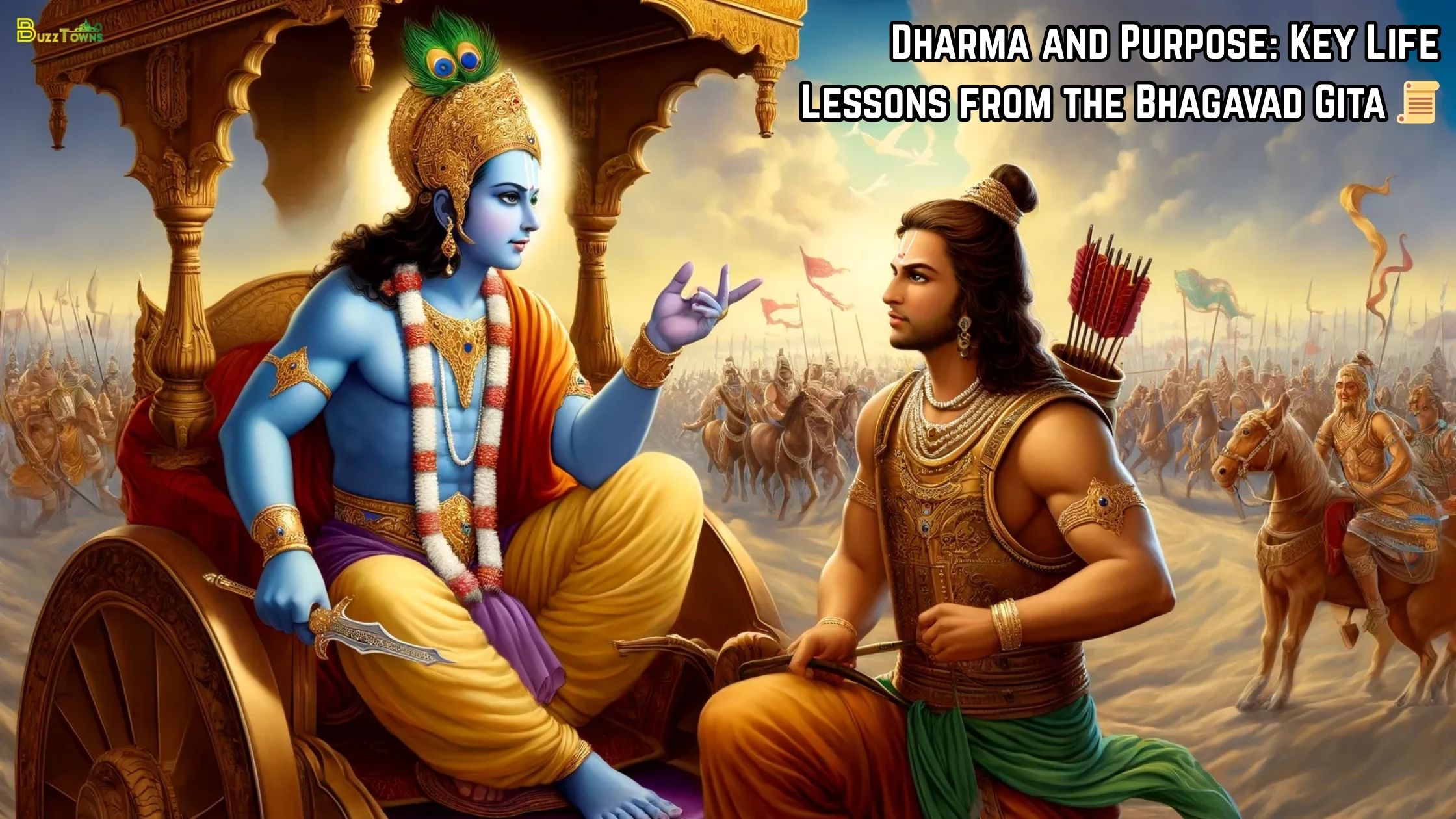
An ancient Hindu scripture, the Bhagavad Gita, is not only a religious text but a deep guide to living a purposeful life. This is a dialogue between Prince Arjuna and his charioteer, Lord Krishna, on the battlefield of Kurukshetra. Facing a moral dilemma, Arjun is hesitant to fight his own relatives, but Krishna’s teachings illuminated the path of religion (duty, righteousness) and liberation, which offers timeless knowledge to navigate the challenges of life. The central subject revolves around fulfilling one’s religion and understanding the real purpose of existence.
The Concept of Dharma: More Than Just Duty 🤔
In the Gita, religion is a versatile concept. It is often translated as “duty” or “righteousness”, but its meaning is very rich. It reflects moral principles that guide a person’s life, which ensures the cosmic and social system. Religion is not a size-fit-all rule; It is reference-specific and depends on one’s nature, role in society, and state of life. The Gita classifies religion into two main types: Swadharma (one’s own personal duty) and Sanatan Dharma (eternal, universal theory).
Lord Krishna urged Arjuna to follow his self-reliance as a warrior (Kshatriya). Their duty is to maintain righteousness and fight for justice, even if it means facing their own relatives. Krishna insists on leaving his own religion, even for good reasons, and more and more pain. This lesson is a powerful reminder that our purpose is often associated with our unique skills, talents and responsibilities.
For us, understanding our svadharma means to recognize our roles as students, parents, professionals, or community members and to fulfill the duties that come with them with honesty and dedication. This is about aligning our tasks with our internal nature, and we are not trying to do anything that we are not. This authenticity is the cornerstone of a complete life.
Karma Yoga: The Path of Selfless Action 🏃♀️
The Gita introduced three primary paths for self-attainment: karma yoga (path of action), devotional yoga (path of devotion), and knowledge yoga (path of knowledge). Of these, Karma Yoga is particularly relevant to those looking for purpose in their daily life. The central teaching of Krishna on this path has been included in a famous poem: “You have the right to perform your prescribed duty, but you are not entitled to the fruits of action. Never consider yourself the cause of the results of your activities, nor should you be associated with inaction.”
This is the principle of disappointing action, or acting without attachment to the results. This means to perform our best and perform our duties with dedication, but abandoning the need to control the result. This contingent is not about apathy or laziness; This is about freedom from concerns and expectations that often affect our efforts. When we work for action for ourselves instead of praise, reward, or recognition, our work becomes a form of worship.
Consider the student studying for an exam. Karma Yoga will have to be involved in the necessary effort, study diligently, and master the material without excessive stress about the final grade. Meditation is on this process, not only the results. This mentality reduces stress and allows for greater concentration and efficiency. By focusing on action, we find a sense of pleasure in this process and a sense of purpose in our efforts.
The Importance of Self-Control and Discipline 🧠
The Gita repeatedly emphasizes the importance of controlling the mind and senses. Krishna teaches that the mind can be our biggest friend or our biggest enemy. A disciplined mind leads to inner peace and clarity, while an uncontrolled mind is a source of anxiety and confusion. This self-harm is necessary to fulfill our religion and achieve our goals.
Yoga is the practice of uniting, in its broader sense, mind, body, and soul. This is a method to achieve this self-control. The Gita provides practical advice on how to achieve it, including mindfulness, attention, and a balanced lifestyle. This emphasizes that a person who has conquered his mind is a true guru of his fate. This mastery allows us to create a conscious option with our religion rather than being driven by fleeting desires or external pressures.
For example, opposing the temptation of laxity to complete an important task is a task of self-control. Choosing a healthy food over junk food is a small win for the brain and the senses. These small functions of discipline build a foundation for a purposeful life.
The Ultimate Purpose: Moksha and Self-Realization ✨
Completing one’s religion is the way, the ultimate goal in the Gita is salvation (liberation) or self-attainment. This is a state of spiritual freedom from the cycle of birth and death, which is achieved by realizing someone’s true nature as part of the divine. Krishna explains that Atman (soul) is eternal and irreversible, different from the temporary body and brain. For example, fear of death is an illusion because the soul is indestructible.
Understanding this truth turns our perspective on life and death. It frees us from fear of harm and attachment to physical property. This allows us to see the challenges of life as opportunities for development and spiritual growth. This high purpose gives meaning to our tasks, which allows us to join the divine every moment.
In our daily life, this understanding can be a source of immense peace. This allows us to withstand difficulties with courage and equality. For example, a person who has lost a loved one can find solitude in the knowledge that the soul is eternal. The person facing a career shock can see it as a temporary stage, which is an opportunity to assess and learning. The chase of salvation converts our attitude into a broad, ubiquitous one from a narrow, ego-centric view.
Practical Lessons for a Modern Life 💼
The knowledge of the Bhagavad Gita is not limited to the battlefield of Kurukshetra; This applies to the battles that we fight every day.
- Find your religion: Take time to reflect on your unique skills and passion. What is your role in your family, community, or workplace? Align your tasks with your real nature.
- Disappointing action: Do your best in every task, but it is not connected to the result. Pay attention to the process, and leave the need for control. It reduces stress and increases your efficiency.
- Practice self-control: discipline your mind and senses. Start with small habits, such as meditating for a few minutes each day or making conscious choices about what you consume in both physical and mental ways.
- Remember the big picture: Stay aware of your high purpose. Your life is not just a series of events; This is a journey of spiritual development. This perspective brings a sense of meaning to every action.
The Bhagavad Gita is a deep guidebook for anyone wishing to live a life of purpose, meaning, and inner peace. Understanding the principles of religion, karma yoga, and our own nature, we can navigate the complexities of modern life with grace and knowledge. It is a timeless reminder that the true victory is not in winning others, but in winning oneself.