
The nine-night festival, Navratri, is a lively and deep spiritual festival of the divine woman in her various forms. Each day of this festival is dedicated to one of the nine incarnations of Goddess Durga, known as Navdurga. On the second day, devotees dedicate their prayers and devotion to the mother Brahmacharini, a goddess, whose story is a powerful reminder of the transformative power of penance, discipline, and unwavering faith. His name itself holds the key to his essence: “Brahma” refers to “austerity” or “penance”, while “Charini” means “a female follower.” Thus, Maa Brahmacharini symbolizes a lot of feelings of harsh spiritual discipline.
The Divine Iconography of Maa Brahmacharini
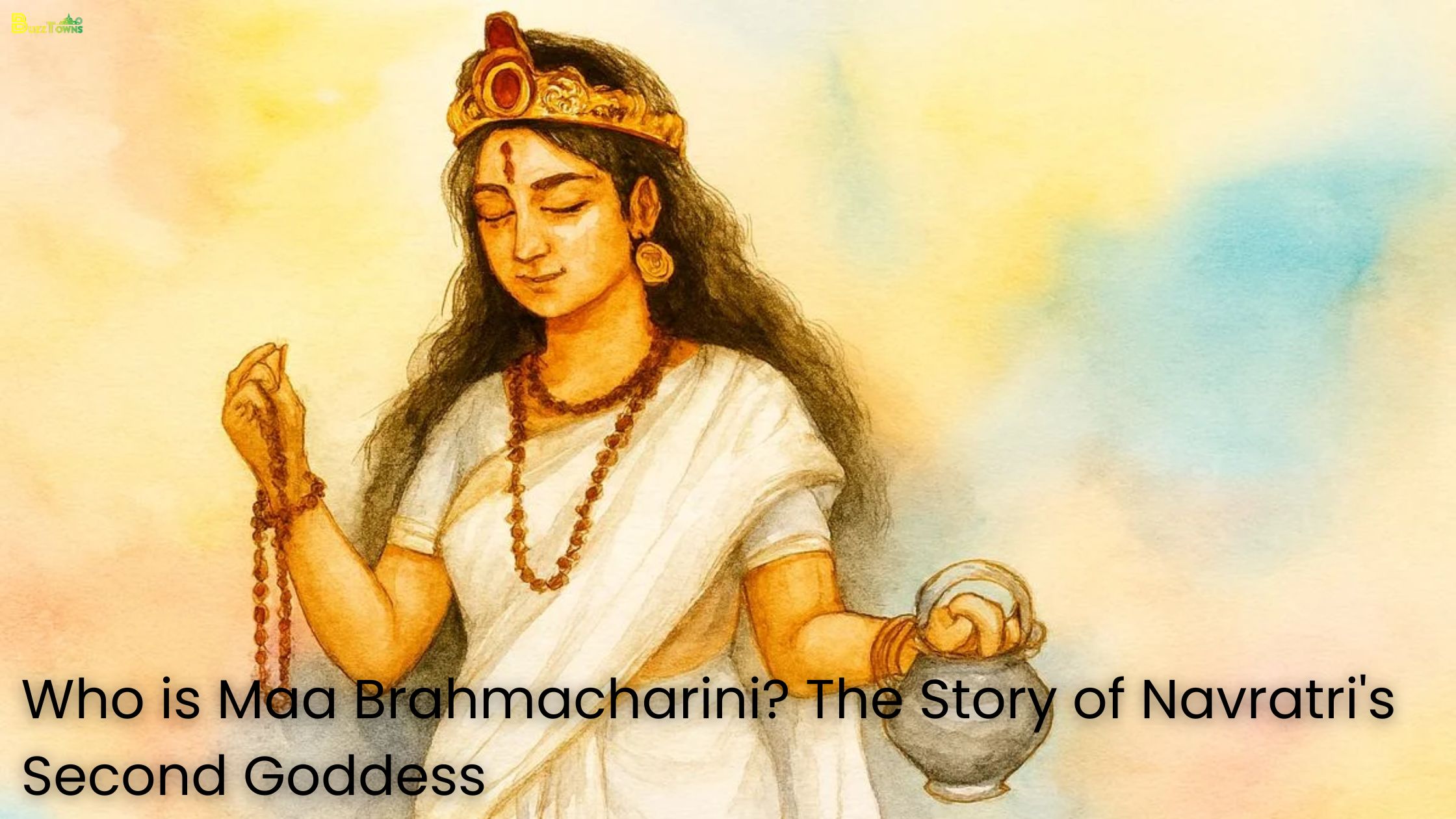
Maa Brahmacharini is depicted as a calm and simple figure, opposite to some more fierce forms of the goddess. She has been depicted barefoot walking, wearing a plain white saree, which is a symbol of purity and detached from worldly desires. In her right hand, she holds a Japa Mala (Rosary), which represents her constant attention and prayer. In her left hand, she bears a Kamandalu (a water pot), which shows her self-reliance and spiritual purification that she has achieved through her penance.
Her calm face reduces the spirit of peace, pleasure, and inner strength, a reflection of intense penance. His posture has a clear feeling of concentrated resolution, a calm yet immense power that comes from an uncontrolled internal desire not with aggression.
The Legend of Parvati’s Penance
The story of Mother Brahmacharini is an integral part of the divine love saga of Lord Shiva and Goddess Parvati. She is an unmarried, ascetic form of Goddess Parvati, who did a monumental penance to conquer Lord Shiva as her husband.
In her previous incarnation as Sati, the first wife of Lord Shiva, he had self-proclaimed herself in the fire of a sacrifice to oppose his father-in-law Daksha’s insult to his divine union. She then used to rebirth as Parvati, the daughter of Himavan, the king of the Himalayas. From a young age, Parvati was fascinated by the stories of Lord Shiva and was appointed as his divine counterpart. However, after the tragic losses of Shiva and Sati, all worldly matters were abandoned, and they retreated from the Himalayas for deep attention, indifferent to them.
To keep her as her husband, Parvati pledged to win her with the sheer force of her devotion and spiritual practice, not with beauty or money. She left her magnificent life and climbed on the path of extreme penance, and went into the forest. His penance was so serious that it is a famous story of devotion in Hindu mythology.
- Early stages: For a thousand years, she survived only on fruits and flowers.
- Next step: She then proceeded to stay on green leaves and herbs for another thousand years, and she earned the Aparna name (one who does not eat any leaves).
- Final Stage: In the last and most difficult phase of his penance, he completely left all food and water. She slept on the bare ground and endured the most rigorous weather – heat, torrential rain, and bitter cold – keeping their attention with unwavering focus on all.
The intensity of his penance created immense spiritual energy and heat, reached the sky, and even shook Lord Shiva with his deep transpirations. To test his devotion, Lord Shiva appeared in front of him under the guise of an old ascetic. He started criticizing Shiva, calling him a mendicant, a wild disrespect, and a princess like him. Parvati, angry with the insults, resolved to defend Lord Shiva, declare her unconditional love, and marry her. Impressed by her strong devotion, Shiva revealed her real form and finally agreed to marry her.
This is an incredible journey of penance and patience that defines Maa Brahmacharini. This is the story of how an uncontrolled desire, a pure heart, and one-minded devotion can also achieve the most impossible goal.
The Deeper Significance and Symbolism
Worship of Maa Brahmacharini goes far beyond a simple ritual; This is an intensive spiritual practice. His story offers valuable lessons for all seekers on the path of self-reform and spiritual development.
- Discipline and penance: Mother Brahmacharini is a symbol of penance, or self-discipline. She teaches that true success, whether spiritual or worldly, is not obtained through a desire to bear, focused efforts, and difficulty. This day encourages devotees to cultivate discipline in their own lives, whether it is a creative project, a health goal, or a spiritual practice.
- Purity and unbreakable devotion: her white dress and pure form represent the purpose and purity of the mind. She shows that devotion should be pure and selfless, unaffected by expectation or worldly desires. Her love for Shiva was so absolute that she was ready to sacrifice everything for it, and the purity of intentions is what finally conquers her.
- Inner strength: By overcoming immense difficulty, Maa Brahmacharini teaches us that our greatest strength comes from within. It is not about cruel force, but is about flexibility, patience, and internal fate to withstand the challenges of life with grace and determination.
- Association of mind and soul: At a deep, esoteric level, the journey of Maa Brahmacharini represents the union of the individual soul (living) with the highest consciousness (Brahmin). His penance is the spiritual discipline necessary to remove the obstacles of the physical world and to achieve his last union with God.
Rituals and Worship on Day 2 of Navratri
On the second day of Navratri, the devotees perform specific rituals to honor the mother Brahmacharini and seek her blessings.
- The color of the day: While the mother Brahmacharini herself is painted in white (symbol of purity), the color associated with the second day of Navratri is often red. Red, vivid energy, represents courage and vitality, which are necessary to meet discipline and perseverance as a goddess. Devotees often wear red to invite this powerful energy.
- Pooja Vidhi: Pooja begins with the formal lighting of a lamp. An idol or image of Maa Brahmacharini is placed on the altar and decorated with flowers, especially white flowers such as jasmine or lotus. Prasad is made, which includes a mixture of milk, curd, honey, ghee, and sugar, which is known as a panchayat.
- Bhoga (offering): Special offers for this day are usually sugar and fruit, which are believed to bring longevity and happiness. Mantra: Chanting mantras dedicated to Maa Brahmacharini is considered a powerful way to join her energy and seek her blessings. The most common mantra is:
Om Devi Brahmacharinyai Namah॥
Dadhana Karpadma Abhyam Aksha Mala Kamandalu |
Devi Prasidatu Mayi Brahmacharinyanuttama ||
This mantra praises the goddess who holds a garland and a water pot in her hands and asks her to make her blessings best. Worshipping Maa Brahmachariini on the second day of Navratri is a powerful reminder that the path of divine connection is one of internal discipline and unwavering devotion. His story is a timeless inspiration, teaching us that true strength is not in the external performances of power, but in the calm, stable resolution of a pure and concentrated mind. By honoring him, we learn to face our own challenges with the same patience and determination, the belief that our deep wishes, when fueled for a pure purpose, actually receive.