As Navratri moves forward, each day reveals a new dimension of the immense power of the divine mother. On the seventh day, we enter a realm of deep intensity, the scary of Maa Kalaratri yet philanthropically bends. Often a terrible scene, painted with a dark color and disorganized hair, Kalari may initially seem hard. Nevertheless, the last promise of safety, liberation and auspiciousness lies within his frightening form.
Her name indicates her nature: “black” means time, death, and dark, while “Ratri” means night. She is “the night of death,” she who brings the end of darkness and ignorance, eats all negativity. She is a terrible expression of Goddess Durga, when the forces of evil become so heavy that only the most formidable power can restore the cosmic order.
Join us because we travel in the heart of his legend, discover his terrible appearance, his important role in destroying invincible demons, and the intensive spiritual lessons that he offers to those who dare to see beyond his scary outside.
The Unstoppable Darkness: When Evil Became Invincible
The arrival of Maa Kalaratri is associated with one of the most epic battles in Hindu mythology – the war against the demons Shumba and Nishumba. These two powerful Asura brothers, through intense penance, acquired a boon that made them almost invincible for male gods and humans. He wreaked havoc in the three worlds, separated the gods, disrupted religion, and hurt all living beings.
When the deity led by Indra repeatedly failed to defeat them, he invited the divine mother, who appeared as Goddess Chandika (or Ambika). Chandika, with her bright beauty, attracted the attention of Shumba and Nishumba, who sent her commanders to catch Chanda and Munda. Chandika, in a boom of anger, removed the mother Chamunda (Kali) from her third eye, who sent dona and Munda rapidly.
However, the war continued with even more formidable enemies, including the notorious demon Raktbija.
Raktabeeja: The Demon of Endless Replications
Raktabeeja was not just powerful; He had a terrible boon: Every drop of his blood touched by the Earth will immediately give birth to another fully formed demon like him. This made him impossible to defeat. As the deities fought, Raktabeeja ‘s blood spread, and the battlefield was overwhelmed by the growing army of its clones. The gods and even the fierce goddess-gods were disappointed, realizing that the traditional war was meaningless.
This was the moment of the last crisis, the night before the morning. This was when Mother Kalari made her formidable appearance.
Born from Fire and Fury: The Manifestation of Kalaratri
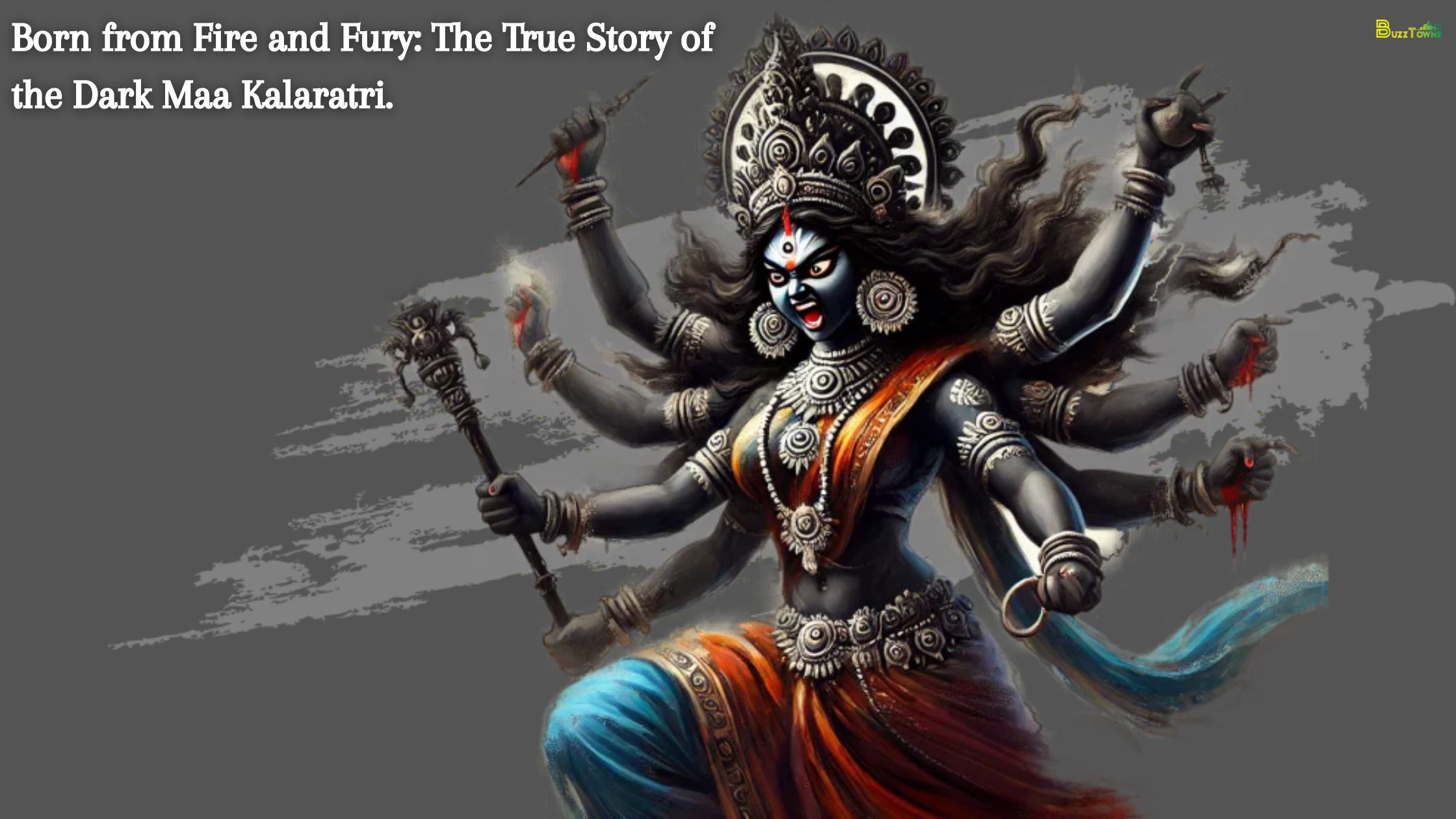
Maa Kalaratri, from the eyebrow of Goddess Durga (or Chandika), in an explosion of unimaginable fury and concentrated divine power, emerged. She was an incarnation of ultimate destruction, a final force to consume all negativity and anarchy.
- Her terrible form: Her color is dark as a moonlit night, radiating a terrible intensity. Near her, wild hair billows, and she wears a garland of skulls around her neck. His three eyes glow with a terrible, red light, which symbolizes all his knowledge and destructive power. The fire originates from his nostrils.
- Her weapons: She usually has four weapons. In her upper left hand, she holds an electric bolt (thunderbolt), which symbolizes the destruction of ignorance, and in her lower left, an iron hook (shatani), control and control. Her right hand is in Varada Mudra (Boon-Giving gesture) and Abhaya Mudra (gesture of fearlessness), who assures her devotees to protect and bless.
- Her vehicle: She rides a loyal donkey, which is often associated with patience and perseverance, but is also able to carry an immense burden.
Her presence itself killed terror in the hearts of the demons, but it was her strategy that brought about the end of Raktabeeja.
The End of the Endless: Slaying Raktabeeja
When Maa Kalari entered the battlefield, she saw the endless herd of Raktabeeja clones. Without any hesitation, she started eating them one by one, who consume demons. Then, she opened her huge mouth and extended her long, terrible tongue, covering the entire battlefield.
As other goddesses attacked Raktabeeja, Maa Kalaratri ensured that not a single drop of her blood touched the Earth. She drank every drop of blood faster and completely as it prevents any new demons from being created. Due to there being no other clone to fill his army again, Raktabeeja was left weak. Mala Kalari then, with her immense power, completely denied it, which ended his terror.
It seems to be an iconic victory that endless problems, repetitive negative patterns, and the destruction of victory over challenges multiply with every effort to solve them. She is a final solution to continuous, heavy negativity.
Shubhankari: The Auspicious Side of Darkness
Despite her frightening appearance, Maa Kalaratri is also known as Shubhanky, which means “who does good” or ” the one who brings auspiciousness.” This contradiction is central to understanding it. She is terrible because she destroys evil, fear, and ignorance. By eliminating these dark forces, it paves the way for light, purity, and positive changes.
Its darkness is not one of despair, but is from the zero, which is the ultimate absorber of all negativity, before the creation. It is the night that brings out the dawn, the darkness that exposes the stars. For her devotees, she eliminates obstacles, cleanses karma, and grants fearlessness.
Maa Kalaratri and the Sahasrara Chakra
Spiritually, Maa Kalaratri Sahsharara Chakra is associated with the Crown Chakra, which is the seat of ultimate consciousness and spiritual knowledge. It is believed that to awaken this cycle, intensive spiritual experience from the cycle of birth and death leads to intuition and liberation. His presence helps in purifying the mind, removing all confusion, and brings clarity.
How to Invoke Maa Kalaratri’s Blessings
Worshipping Maa Kalaratri on the seventh day of Navratri is very important:
- The color of the day: The auspicious color is gray or black, which symbolizes its power to destroy evil and absorb negativity.
- Prasad: Jaggery (Guru) is his favorite offering, which is a symbol of sweet happiness after overcoming difficulties. Other offerings include red flowers, fruits, and incense.
- Mantra: Chanting his specific mantras is highly powerful:
- “Om Devi Kalaratryai Namah” (Salutations to Goddess Kalaratri)
- “Om Aim Hrim Klim Chamundaye Vichche” (A powerful Navarna Mantra associated with Chamunda/Kalaratri)
- “Ekaveni Japakarnapura Nagna Kharasthita | Lamboshthi Karnikaparana Tailabhyakta Sharirani || Vamapadollasallohalta Kantakabhushanabhushita | Vardhan Murdhadhwaja Krishna Kalaratrirbhayankari ||” (This descriptive mantra invokes her fearsome yet benevolent aspects.)
- Meditation (meditation): Meditate on her terrible form, imagine her fear, doubt, and destroy all the negative energies around you. Feel that her protective shield is covering you.
- Internal changes: Beyond rituals, actually respecting Maa Kalaratri with the courage to face your own internal dark (fear, anger, ignorance) and demand to change it. This means that sometimes, destruction is necessary for true creation.
The Timeless Message: Embrace the Darkness to Find the Light
Maa Kalaratri’s story is a deep reminder that life is not always light and easy. Andheri nights, formidable challenges, and endless struggle appear. But even in the deepest darkness, there exists a protective, cleansing, and converting divine power. She teaches us that fear is an illusion, and by facing our fear, we unlock immense internal strength.
Her dark form is not feared to be afraid, but is revered, as it is the ultimate expression of the unwavering commitment of the divine mother for truth and righteousness. She is a kind destroyer who is clearing the way for auspiciousness, prosperity, and spiritual awakening. So, on this seventh day of Navratri, let us not shy away from the intensity of Maa Kalaratri. Instead, let us embrace her fierce energy, allowing her to consume our fears, purify our souls, and guide us towards the light of true wisdom and liberation. Hail Maa Kalaratri, the Shubhankari!