
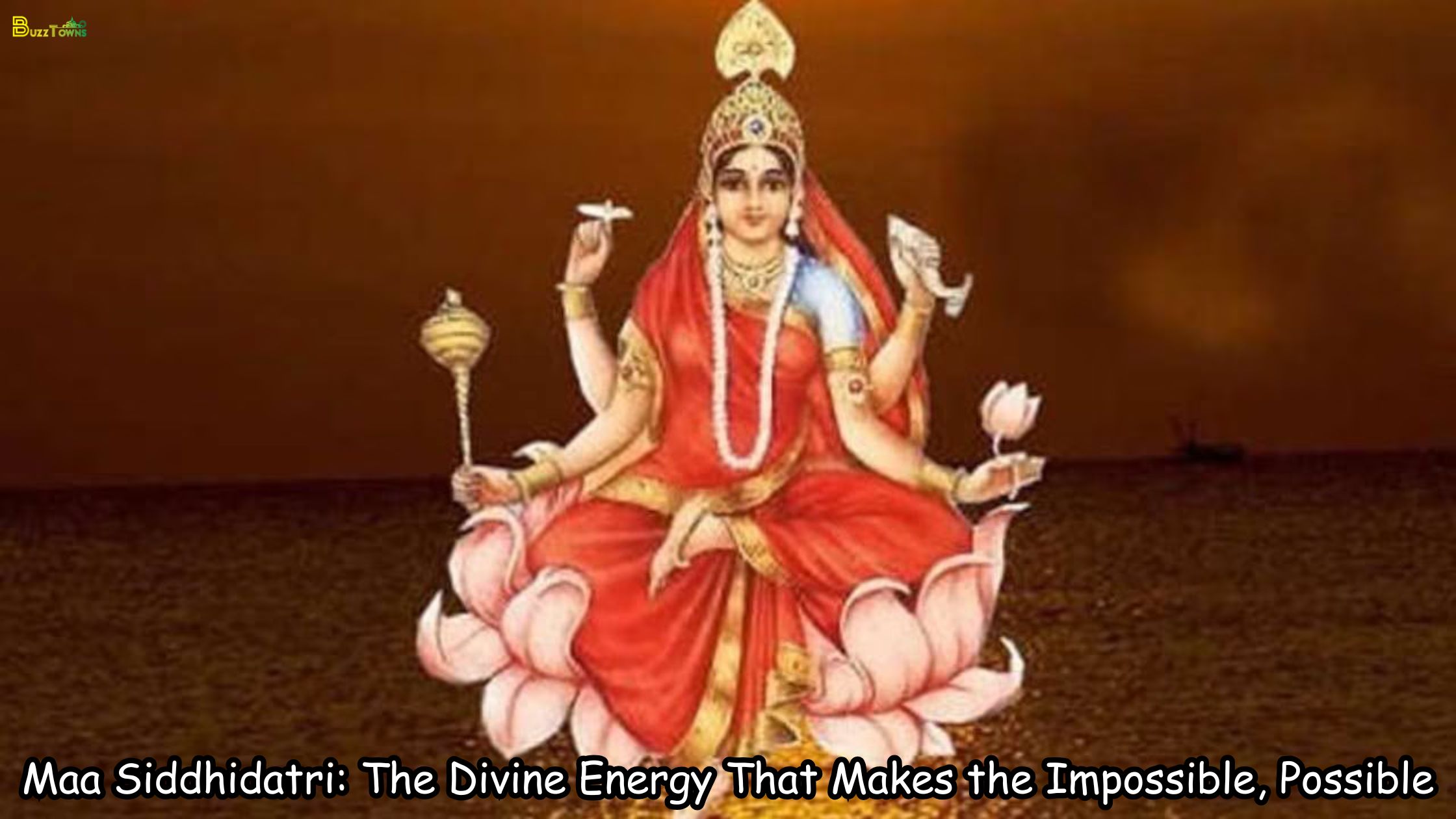
A spiritual journey, like a grand epic, should eventually reach its brilliant conclusion. In the cycle of Navdurga, the nine expressions of Divya Maa Durga, this result is depicted by the Maa Siddhidatri, the ninth and final form. Worship was performed on the auspicious day of Maha Navami. She is the goddess who symbolizes perfection, spiritual attainment, and the ultimate fulfillment of all desires. Her very name, the Sanskrit word Siddhi (supernatural power, perfection, or achievement), and a combination of donor (donor or bester) reveal its essence: the donor of all Siddhas.
To worship Maa Siddhidati, one must seek the ultimate, divine seal, which transforms the aspiration into full reality. It is a philanthropic power that validates the entire nine-day spiritual discovery, proving that through devotion and discipline, no goal is out of physical or spiritual reach. She is quite literally the goddess who makes impossible possible.
The Origin: Lighting the Primordial Void
The legend of the emergence of Maa Siddhidati is an amazing story of the cosmic creation, which keeps it not only at the end of the Navdurga Chakra, but also at the beginning of the universe.
Hindu scriptures, especially the Puranas, describe a time when the universe was nothing but a huge, all-inclusive zero of darkness. There was no existence, no form, and no movement. It was from the cosmic emptiness that a magnificent, bright light – Aadi Parashakti (Supreme Goddess) – Sudenli appeared. This formless light gradually took the shape of a divine woman, supreme power.
From the infinite energy of the superpower, the holy trinity – Brahma, Vishnu, and Shiva – was brought forward. They were tasked with the roles of creation, protection, and destruction, respectively, but they lacked the necessary powers to start their vast tasks. The supreme goddess advised the three Lords to do deep penance to understand their purpose and gain their powers.
Pleased with their dedicated penance (penance), Mahashakti appeared in front of him in a bright form of superpower.
Bestowing the Cosmic Framework
The first task of Maa Siddhidati was to determine the stage for the entire universe. She:
- Granted their Consorts: Devi honored Trimurti on her divine concerts: Saraswati (Goddess of knowledge) to Brahma, Lakshmi (Goddess of wealth and prosperity) to Vishnu, and Parvati (Goddess of power and union) to Shiva. She announced that their powers would reside in their wives, which would lead to the necessary duality for creation.
- Define the roles: She confirmed their cosmic duties: the creator as Brahma, Vishnu as Vishnu, and Shiva as the destroyer/transformer.
- Siddhis performed: The most important thing is that she gave them to help them fulfill their duties, along with nine treasures and ten other supernatural powers, along with the famous eight Supreme Siddha (Ashta Siddhi). With these divine powers, Trinity was finally equipped to bring the universe into existence, in which Ma Siddhidati was marked as the all-powerful authority and the last source of perfection.
The Eight Great Perfections: The Ashta Siddhis
The most defined aspect of Maa Siddhadati is her ability to give eight Supreme Siddhis (Asht Siddhis). These are not just magical moves; They are advanced states of spiritual and physical mastery that represent the culmination of a yogi’s journey.
| Siddhi | Meaning | Description of Power | Spiritual Significance |
| Anima | Minute Size | The ability to reduce one’s body to the size of an atom (smallest possible form). | Humility, reduction of ego. |
| Mahima | Immense Size | The ability to expand one’s body to an infinitely large size, encompassing the universe. | ‘Think Big,’ realizing universal consciousness. |
| Garima | Infinite Weight | The power to become infinitely heavy, making one immovable. | Steadfastness, unshakeable values. |
| Laghima | Weightlessness | The power to become weightless, enabling levitation and flying. | Detachment, freedom from earthly burdens. |
| Prapti | Attainment | The power to acquire or access anything, anywhere, instantly (e.g., touching the moon with one’s finger). | Focused attention, mastery over goals. |
| Prakamya | Irresistible Will | The ability to fulfill any desire, live submerged in water, or achieve an irresistible will. | Truthful expression of intent, courage. |
| Ishitva | Lordship | The power of absolute lordship or supremacy over all elements of creation. | Leadership, ethical command, control over one’s own nature. |
| Vashitva | Mastery | The ability to bring others or natural forces under one’s control (Vashikaran). | Self-control, mastery over emotions and elements. |
The blessing of Maa Siddhidati shows that her devotees can also achieve any of these perfections, because they have miraculous tricks or someone’s mind and life.
The Ardhanarishvara Connection: The Fusion of Opposites
Another intense story related to Maa Siddhidari highlights Lord Shiva’s role in the creation of the Ardhanishwara form.
After attaining the great siddhis from the goddess, the form of Lord Shiva changed. According to the scriptures, when Mother Siddhidari was pleased with the immense penance of Shiva, she merged with her left half, resulting in a colored form of Ardhanrishwara – the Lord whose half is a woman.
This eternal form is not just a beautiful deity; This is a deep philosophical statement:
- Unity of duality: Ardhanrishwara is a symbol of masculine theory (male, or consciousness) and feminine theory (Prakrit, or energy/substance) in a symbol of the inseparable and essential union.
- Completeness: It teaches that creation and existence are only fulfilled when both energies are in the right balance and harmony. The Ardhanishwara form brought beyond the grace of Siddhidatri is a divine model for the form, cosmic and personal perfection.
Iconography: The Symbol of Fulfilled Power
The iconography of Maa Siddhidatri surrounds her role as the best and controller of all construction.
- Four-Sastra Devta: She is usually painted with four hands, a number that symbolizes the completion of the four directions and the four stages of balance and life.
- Divine characteristics: She holds a cycle (discus) to bite through negative karma and confusion, a cone (conch) symbolizes the voice of victory and the primitive sound of creation, represents a gada (mace) power and the final blow to the ego, and a complete bloom, indicating purity for spiritual consciousness.
- Mount: She is sitting on a full-blooming lotus and also rides a lion, which symbolizes the total victory over animalistic tendencies and the complete bloom of purity on the raw force of power.
- Worshipers: In her presence, all beings -Gods (deities), astronomical musicians (Gandharvas), Nature Spirits (Yaksha), Rishi (Siddha), and even looked at the demons (asuras), recognizing him as a source of power and perfection.
The Spiritual Significance: The Crown of the Journey
Mother Siddhidari is the goddess of Nirvana Chakra (Sahasharara Chakra or Crown Chakra), which is the highest energy center in the subtle body, located at the top of the head.
Worshipping Siddhidati on the last day of the nine-day cycle is a deep symbol of a spiritual journey:
- The culmination of discipline: The first eight days of Navratri represent purification, self-control, and inner demons (ego, desire, greed, etc.) to victory. Siddhidati represents the success of this whole effort, the moment a disciplined seeker receives a full feeling.
- Beyond the mind: The activation of the Crown Chakra indicates the boundaries of the physical body and the boundaries of the mind. The grace of Maa Siddhidati allows the devotee to think “out of the box”, which enables miracles and achieving the goals that seemed impossible by simple means.
- Final blessings: Her blessings are the key to both material and spiritual achievements (enjoyment and salvation). She ensures that the knowledge and knowledge of the seeker is fulfilled, providing the necessary clarity and courage to carry forward the highest capacity. Once perfection is achieved, it forces the feeling of realization to guide others, thus ensuring the continuity of divine discovery.
To worship Maa Siddhidari, the ultimate, fierce desires of one on the altar of supreme power have to be presented, not only asking someone to achieve worldly and spiritual desires, but also to incarnate the necessary perfection to maintain that attainment. It is the last destination, Siddhi, and divine assurance that every earnest effort will be crowned with final success.





. Discover her role in creation, the **Ardhanarishvara** form, and how she makes the impossible possible.)