
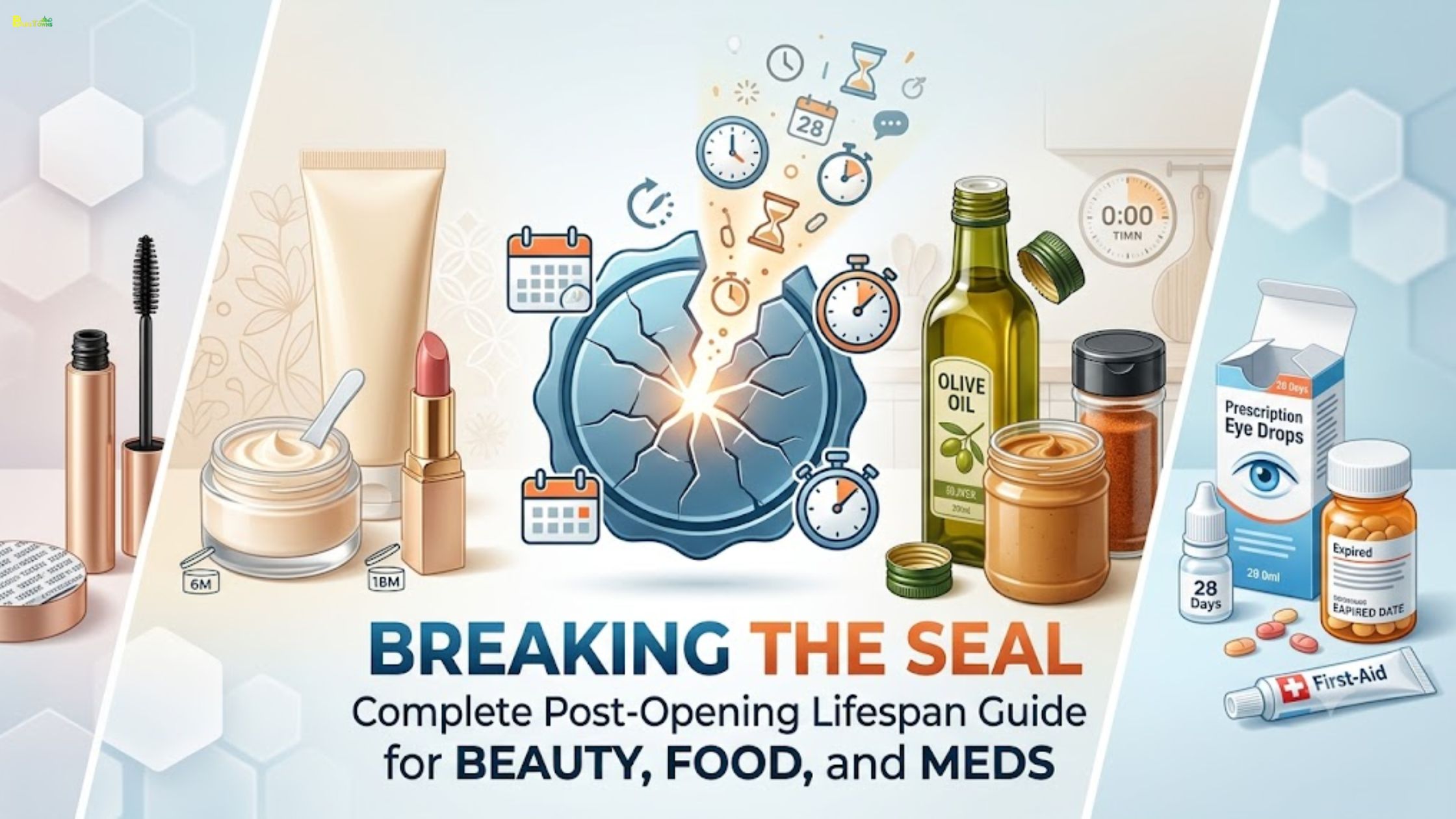
You check the bottom of a bottle and breathe a sigh of relief: “Expires November 2028.” Not so fast. That printed expiration date comes with a major caveat: it only applies while the factory seal remains intact. The instant you peel back foil, pop a cap, or click a seal, that distant year-long timeline vanishes. In its place begins an entirely new, much shorter countdown known as the post-opening shelf life.
Whether it’s mascara harbouring bacteria, olive oil going rancid in your pantry, or eye drops turning hazardous, here is what actually happens once you break the seal—and how long your everyday essentials truly last.
The Open-Jar Mystery: Understanding PAO
Turn over almost any cosmetic tube or serum, and you’ll likely spot a tiny graphic of an open jar marked with a number and the letter M (e.g., 6M, 12M, 24M).
This is the PAO (Period After Opening) symbol. It dictates the maximum number of months a formulation remains stable, sterile, and effective after exposure to air.
- If a product says EXP 2028 but has a 6M symbol, and you open it today, it expires in 6 months—not in 2028.
Why Does Breaking the Seal Change Everything?
Three environmental triggers initiate rapid degradation the moment a container opens:
- Oxidation: Contact with atmospheric oxygen triggers chemical chain reactions. Unsaturated fats turn rancid, and active ingredients (like Vitamin C or retinol) lose potency.
- Moisture & Evaporation: Humid air feeds fungal spores, while water-based solvents evaporate, drying formulas out and destabilizing preservative matrices.
- Microbial Contamination: Dipping fingers into a cream jar or sweeping a mascara wand across eyelashes transfers yeasts, bacteria, and skin flora straight into the bottle.
1. Beauty & Skincare: From Glow to Bacterial Trap
Because cosmetics frequently touch mucous membranes and broken skin barriers, using unsealed products past their prime carries’ real risks: breakouts, contact dermatitis, and ocular infections.
| Product | Post-Opening Lifespan | Why It Fails | Signs It’s Expired |
| Mascara & Liquid Liner | 3 months | Repeated pumping introduces air and eye flora directly into a dark, moist tube. | Chemical/gasoline smell, flaking, clumping. |
| Liquid Foundation / Concealer | 6–12 months | Water-based emulsions destabilize; natural skin oils from applicators break down preservatives. | Oil separation, streaky application, sour odor. |
| Active Serums (Vitamin C, Retinol) | 1–3 months | Highly sensitive to light and air; rapidly oxidizes into inactive byproducts. | Shifts from clear/pale champagne to deep amber/brown. |
| Jar Moisturizers | 6 months | Finger dipping creates a high microbial load with every use. | Watery separation, textural graininess, discoloration. |
| Powders (Blush, Eyeshadow) | 18–24 months | Lacks water, making bacterial growth slower, though surface oil transfer can spoil it. | Hard, shiny film over the top; faded pigmentation. |
| Sunscreen (SPF) | 6–12 months | Active chemical filters degrade, leaving you with zero protection despite normal texture. | Formula separates into liquid and chalky lumps. |
2. Food & Pantry: When “Best By” Becomes Days, Not Years
In food, shelf-stable packaging relies on vacuum sealing, nitrogen flushes, or heat sterilization. Once opened, air and humidity welcome mold spores, yeasts, and foodborne pathogens.
| Product | Shelf Life Once Opened | Storage Rule | Signs It’s Expired |
| Canned Goods (Soups, Beans, Tuna) | 3–4 days | Never store in open can; transfer to glass/airtight container. | Metallic smell, foamy bubbling, gray film. |
| Mayonnaise & Cream Dressings | 2 months | Refrigerator only. | Yellowing, curdling, separation of liquids. |
| Cooking Oils (Olive, Sesame, Canola) | 3–6 months | Cool, dark pantry (away from stove heat). | “Crayon-like”, putty, or bitter taste/smell (rancidity). |
| Nut Butters (Natural / No Additives) | 2–3 months | Refrigerator slows oil oxidation. | Sharp, paint-like odor, bitter aftertaste. |
| Soy Sauce & Vinegar | 12 months | Refrigerator preserves optimal flavor. | Murky sediment, loss of pungent aroma. |
| Ground Coffee | 2–4 weeks | Airtight container away from light. | Flat, cardboard flavor, absence of blooming foam. |
3. Medications & First Aid: Potency vs. Toxicity
With medicines, the danger is rarely a foul smell or visual mold. Instead, post-seal degradation typically means a loss of therapeutic potency or unseen microbial contamination.
| Product | Post-Opening Lifespan | The Hidden Risk |
| Prescription Eye Drops | 28 days (4 weeks) | Eye drops do not contain heavy preservatives. Using them past 28 days risks serious corneal infections. |
| Reconstituted Liquid Antibiotics | 10–14 days | Powder mixed with water degrades rapidly. Discard immediately after the prescribed treatment window. |
| Hydrogen Peroxide / Rubbing Alcohol | 1–3 months (Peroxide) / 12 months (Alcohol) | Peroxide breaks down into harmless, ineffective plain water upon air contact; alcohol evaporates. |
| Insulin Vials / Pens | 28 days at room temp | Molecular stability collapses; unpredictable blood glucose control results. |
| Liquid Cough & Cold Syrups | 6 months | Sugar crystallizes on bottle rims, trapping dust and ambient bacteria. |
How to Protect Your Stash: 3 Golden Rules
- The Sharpie Method: Whenever you open a high-risk product (eye drops, mascara, active serums, condiments), write the opening date directly on the label using a permanent marker: Opened: 10/24.
- Ditch the Dipping: For skincare, use a clean cosmetic spatula instead of fingers to keep jars free of skin bacteria. For food, never double-dip a used utensil into jars of jam or mayonnaise.
- Control the Environment: Heat and humidity accelerate degradation exponentially. Move beauty products and medications out of warm, steamy bathrooms into a cool bedroom drawer or medicine cabinet.
Bottom Line
A printed expiration date tells you how long a product can wait on a shelf for you. The seal is what protects that promise. Once cracked, trust your senses, mind the PAO label, and when in doubt—throw it out.