The holy nine nights of Navratri are a journey through the nine divine forms of Goddess Durga, each of which is a powerful symbol of power, grace, and power. On the fourth day, the spiritual discovery reaches a decisive platform with the worship of Mahadevi Kushmanda, the fourth of Navadurga. His very name, his bright form, and her mythological functions establish her as one of the most important and cosmic intensive manifestations of the divine mother.
He is not only the god of worship; He himself is the fundamental power of creation. His story is the origin of existence, reminding every devotee that the same can emerge through the same, light, heat, and life through the same, divine smile.
Unveiling the Cosmic Architect: The Meaning of ‘Kushmanda’
The name ‘Kushmanda’ is a deep Sanskrit compound word that enhances her primary divine role:
- ‘Ku’ (कु): Signifies a small or little.
- ‘Uṣmā’ (ऊष्मा): Means warmth, heat, or energy.
- ‘Aṇḍa’ (अण्ड): Means an egg, the cosmic egg, or the universe (Brahmanda).
Thus, Kushmanda, “one who created a little cosmic egg (universe) with his warmth and energy.” She is often called ‘smiling goddess’ or ‘cosmic egg maker’ because her legend states that she exists not with a powerful roar, but with a soft, illuminated smile.
The Genesis of Light: Maa Kushmanda’s Creation Myth
He plays the most compelling and unique aspect of the story of Maa Kushmanda as Adi Shakti (Primordial Force) in the creation of the universe.
1. Zero and divine smile
According to Hindu Puranas, before the universe we know – before the stars, planets, sun and moon – only a huge, formless, black zero, dark and full of silence. Life existed, and darkness ruled the supreme.
It was nothing, absolutely, that a luxurious, shining, and formless divine light suddenly spread everywhere. This Prakash then thickened and assumed the philanthropist, panoramic form of Goddess Kushmanda.
The Miracle: It is believed that with a mere, soft, and captivating smile, Maa Kushmanda created Primordial Cosmic Energy. This energy launched the ‘cosmic egg’ (Brahmanda). His smile illuminated the whole zero, thrown out the eternal darkness, and generated the fundamental energy required for life. She is truly the mother who gave birth to the universe.
2. Residing in the Core of the Sun
Maa Kushmanda is the only deity capable of living in the origin of the Sun. Given the immense, unbearable heat of the Sun, this achievement outlines its immense energy and shiny talent.
- It is believed that he has settled his power (power) within the Sun, which is the source of all energy and light for our visible universe.
- It is its brightness that brightens the Sun, and its power that enables the Sun to maintain life on Earth. For this reason, he is sometimes known as ‘Surya Mandla Antvardini’ (one who lives within the solar orb). He not only created the universe, but also maintained its delicate energy balance.
3. Divine triad and continuity of life
After the creation of Brahmanda, Maa Kushmanda continued her cosmic work by revealing the creative forces required to build and maintain the world. He, along with the three supreme Goddesses -Mahakali, Mahalakshmi, and Mahasaraswati -and with his associations is associated with the divine Trinity (Trimurti) of Brahma, Vishnu and Shiva. He then assigned them with the task of continuing, preserving, and dissolving the universe, ensuring the continuity of the cosmic cycle.
In this way, Mother Kushmanda is Jagatprasuti – the mother who gives birth to the universe and is the last, fundamental source of power, energy, and life.
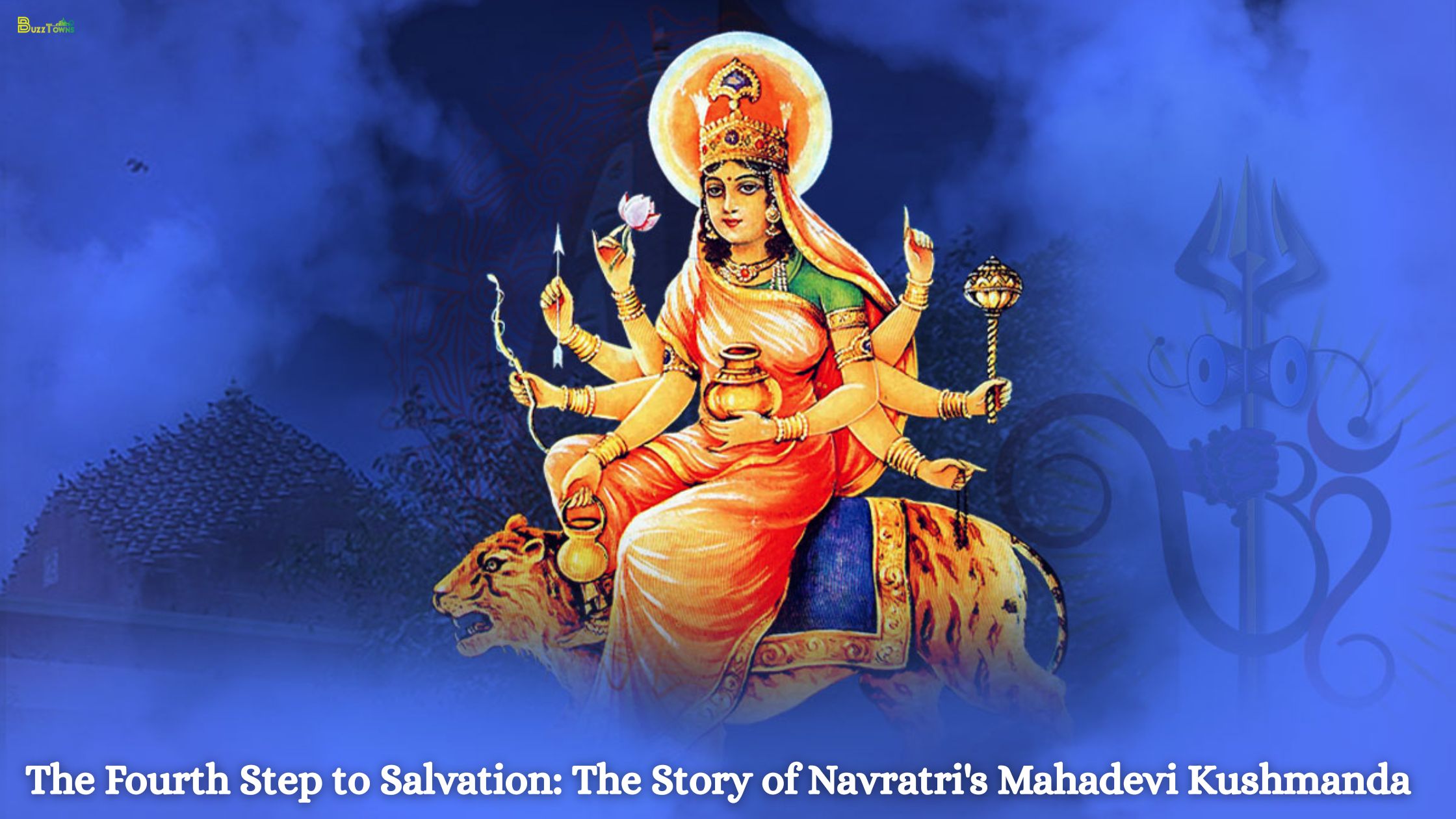
The Radiant Iconography: Ashtabhuja Devi
Maa Kushmanda is known as Ashtabhuja Devi (eight-Sastra Devi), and every element of her portrayal symbolizes cosmic power and divine purpose:
- The eight weapons: They represent eight directions (Ashta-Dish), reflecting their command all over the universe.
- The Lion Mount: She rides a lion, symbolizing religion (righteousness), power, and complete fearlessness. By riding a lion, she creates courage among her devotees to face any challenge.
- A chanting Mala (Rosari): It reflects its power to his devotees to grant Ashta-Siddhis (eight supernatural powers) and neo-nidhis (nine treasures), which provide both material and spiritual abundance.
- Kamandalu (water vessels): The symbol of purity and water of life, which represents its nourishing nature.
- Amrit Kalash (Amar Amrit’s pot): Represents the energy that gives eternal life, which he has and is the best.
- These represent the full spectrum of divine power: bow and arrow, discus (cycle), mace (mada), and lotus: from the fierce fierceness required to destroy bad (weapons), to tenderness and beauty and beauty for beauty and development (lotus).
Significance in the Spiritual Journey: The Anahata Chakra
On the fourth day of Navratri, the worship of Maa Kushmanda is associated with the purification and activation of a specific energy center in the human body: Anahata Chakra, or Heart Chakra.
- Emotional and spiritual core: Anahata Chakra is a seat of love, compassion, harmony, and fearlessness. It acts as a bridge between the lower (material) and upper (spiritual) cycles.
- Healing and balance: Devotees who struggle with anxiety, fear, depression, or emotional imbalance are urged to meditate on Maa Kushmanda. Its solar energy is believed to heal the heart, restore emotional balance, and fill the devotee with a bright, positive aura.
- Inner Radiance: By inviting his grace, a spiritual aspiration begins to internalize his qualities – the ability to find light even in the dark of time, heat, and the ability to find light. Pooja is a step towards attaining self-light, which shines to the devotee with inner light, like a goddess herself.
Rituals and Blessings: How to Worship the Cosmic Creator
The rituals for Maa Kushmanda are centered around purity, light, and the color yellow, symbolizing the brightness, joy, and energy of the sun.
- Pooja Rang: Devotees traditionally wear a yellow dress on this day.
- Prasad (Bhog): He is considered pleased with a prasad (a pumpkin dessert), curd, or a prasad made of coconut. The offering of pumpkin gourd is itself symbolic, connecting the devotee to the ‘cosmic eggs’ of creation.
- Mantra for Roshni: The most powerful way to invite him is to recite his bee mantra:
Om Devi Kushmandayai Namah∣∣
The Blessings She Bestows
Worshipping Maa Kushmanda with true devotional promises:
- Health and longevity: His solar energy removes darkness and disease; a devotee provides strong health and extended life.
- Prosperity and success: He is a source of creation and energy, blessing his worshipers with creativity, vitality, and fulfillment of all desires.
- Inner peace: She cleanses the heart, removes fear, and brings clarity, knowledge, and intense inner peace, leading to the final state of salvation (liberation).
Conclusion: The Path to Divine Illumination
Worshipping Mala Kushmanda on the fourth day of Navratri is a deep lesson in the power of the divine woman. After witnessing the fierce battle of Chandraghant, the devotee now moves to the light of the origin of all life.
“The fourth phase to salvation” is not the ability to make, maintain, and shine, but is deep within the untrical cycle – the heart. By connecting with Maa Kushmanda, the devotee is inspired to be a source of warmth, love, and light in a world that is often immersed in ignorance. His smile, who created Brahmanda, became a guiding theory for a life lived with purpose, compassion, and bright bliss, which determines the path towards ultimate spiritual liberation.